

Contact us
If your Canadian business is spending too much time on repetitive content tasks, Let’s Nurture can help you identify practical automation opportunities and connect the systems your team already uses.


Content Workflow Automation Solutions help Canadian SMBs reduce repetitive content work, speed up approvals, and keep marketing moving without adding more manual tasks to an already busy team.
The need is becoming clearer as Canadian businesses adopt AI and automation. Statistics Canada reported that 19.2% of Canadian businesses used AI to produce goods or deliver services in the 12 months leading up to its Q2 2026 survey, up from 12.2% a year earlier. In the latest Q3 2026 survey, 25.2% of businesses said they planned to use AI over the next 12 months. The numbers show that AI-powered automation is moving from an experiment to a real business priority.
For a small or mid-sized business, however, automation is not about adding another complicated platform. It is about removing the small tasks that slow the team down: moving information between tools, chasing approvals, updating spreadsheets, scheduling content, and repeating the same work every week.
Content Workflow Automation Solutions connect the steps involved in creating, reviewing, approving, publishing, and measuring content. Instead of asking employees to manage every step manually, automated content workflows move work from one stage to the next based on clear rules.
A typical content workflow looks like this:
Plan > Create > Review > Approve > Schedule > Publish > Measure
This is different from simply using an AI writing tool. Content workflow automation covers the content creation process around the writing itself.
For example, when a blog brief is completed, a workflow can automatically assign it to a writer. Once the draft is ready, it can notify an editor. After approval, the content can move to scheduling and publishing.
This type of content process automation gives teams a more reliable content management workflow while reducing repetitive tasks. If your team is still managing this manually, it may help to understand why your small business needs a blog and the process behind it.
A business first identifies a repeatable process. The automation platform then connects tasks, people, software, and rules.
For example, a Canadian professional services company could create a workflow where:
This creates a connected workflow rather than a collection of separate tasks. For teams looking to go further with this, exploring how to use automation with digital marketing to boost profit margins is a useful next step.
Small teams often face a simple problem: there is more content to manage than time available to manage it.
A marketing manager may be responsible for blogs, social media, email campaigns, website updates, SEO, reporting, and customer communication. When every step is manual, even a small delay can affect the whole campaign.
Repetitive work is one of the biggest opportunities for automation.
Copying information between systems, sending approval emails, creating recurring tasks, renaming files, checking publishing dates, and updating reports are useful tasks, but they do not always need human attention.
Task automation can handle these steps while employees focus on strategy, customer needs, creative decisions, and business growth. Broader examples of this are covered in 25 business processes you can automate using Microsoft 365.
Content automation for SMBs is especially useful when a company wants to increase output without immediately increasing its team size.
A well-designed workflow can support more campaigns, more content formats, and more publishing activity while keeping the process organized.
That makes content workflow automation for small businesses a practical option for companies that are growing but still have limited marketing resources.
One of the most common questions businesses ask is, “What content tasks can be automated?”
The answer is broader than content generation.
Teams can automate recurring content tasks such as:
This makes content planning more consistent and gives everyone a clear view of upcoming work.
AI content tools can support research, outlines, first drafts, summaries, content repurposing, and variations for different channels.
The goal should not be to remove human writers or editors. Instead, an automated content creation workflow should reduce the amount of time spent on repetitive preparation.
Human review remains important for brand voice, facts, local context, and quality. A related read on how content intelligence enhances your digital transformation strategy explains how this fits into a wider system.
Approval delays can stop an entire campaign.
Content approval automation can automatically send drafts to the right person, remind reviewers, record approval status, and move approved content to the next stage.
This is particularly useful when several people are involved in the content approval process.
Once content has passed review, content publishing automation can help schedule blog posts, social updates, email campaigns, and other digital content.
This reduces last-minute work and supports more consistent content distribution.
Automation can also connect publishing activity with reporting.
A business can track traffic, engagement, conversions, campaign results, and other useful measures without manually combining information from several systems.
This is where content operations automation and content operations software can provide value beyond basic content creation.
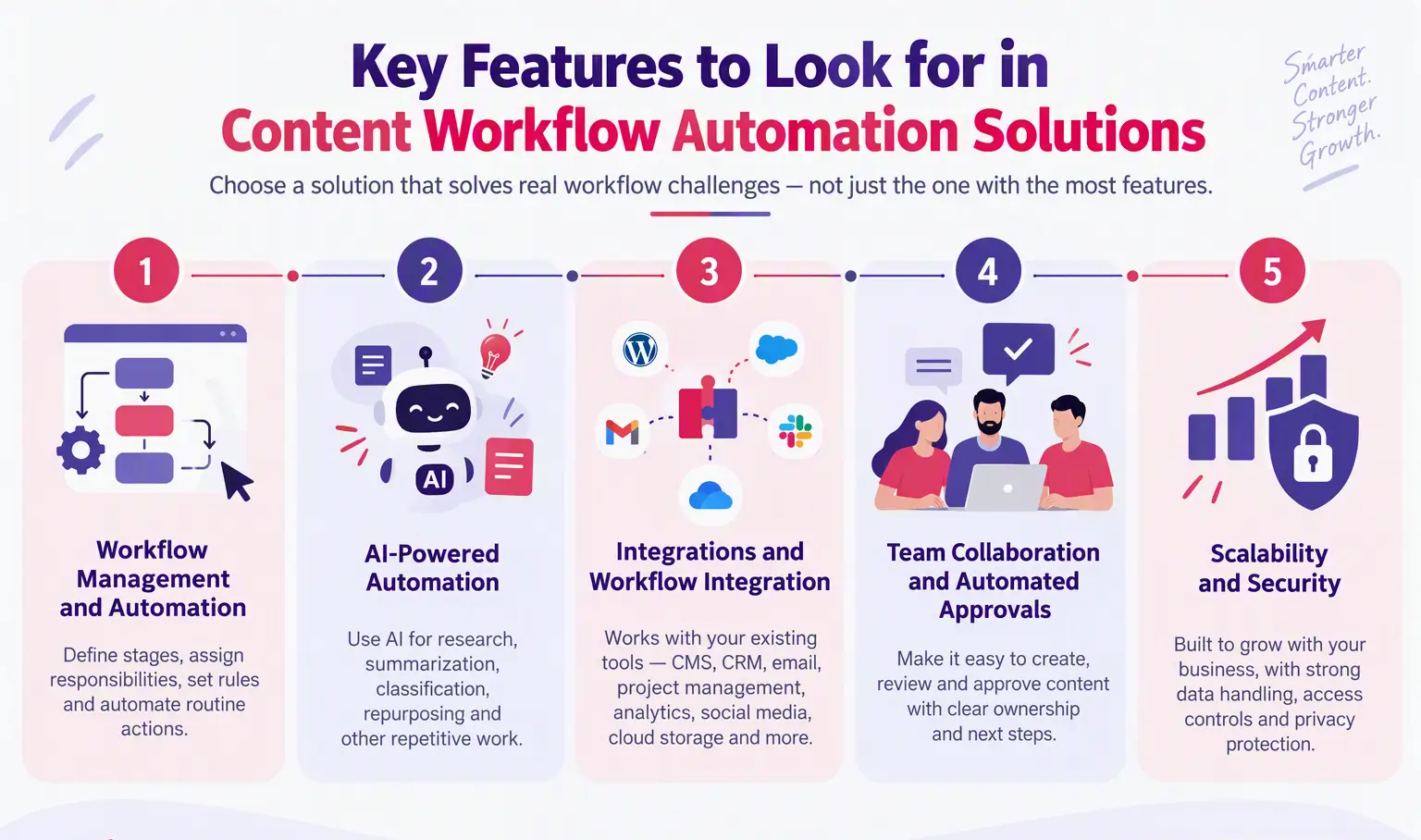
Not every platform is a good fit for every SMB. The right solution should solve a real workflow problem rather than simply offer the largest number of features.
Look for flexible workflow management that lets your team define stages, assign responsibilities, set rules, and automate routine actions.
A visual workflow builder can make business process automation easier for non-technical teams. If your organization is still formalizing processes, reviewing how to implement agile methodology in your organization can help you structure workflows before automating them.
AI-powered automation can support content research, summarization, classification, repurposing, and other repetitive work.
AI content tools should be treated as part of a larger workflow rather than the entire solution.
A useful content workflow platform should work with the systems your company already uses.
Depending on your business, that may include:
Good workflow integration prevents teams from creating another disconnected process. This is closely tied to integrating CRM with marketing automation for improved customer experience.
Strong content collaboration tools make it easier for writers, editors, managers, designers, and business owners to work together.
Automated approvals should also make responsibility clear. Everyone should know who needs to review content and what happens after approval.
The best content workflow software for growing businesses should work when the company has more content, more users, and more campaigns.
Canadian SMBs should also consider data handling, access controls, security, and privacy before connecting sensitive business information to an automation platform. A useful reference is this guide on understanding HIPAA & PIPEDA compliance.
There is no single best solution for every business.
Off-the-shelf content workflow software is useful when a company has standard processes and wants a faster implementation.
It can provide ready-made workflow management, content scheduling, collaboration, and reporting features.
Businesses that want to add AI to existing processes can use AI content workflow automation for SMBs.
This approach may include AI-assisted writing, content classification, summarization, repurposing, and automated task routing.
Some companies have unique systems that do not fit standard software.
In these cases, content process automation services can connect existing platforms and create business-specific workflows.
Custom automation can be useful when a company needs a specific CRM-to-CMS process, custom approval logic, or integration between several internal systems. This is similar to the value described in what you need to know about robotic process automation (RPA).
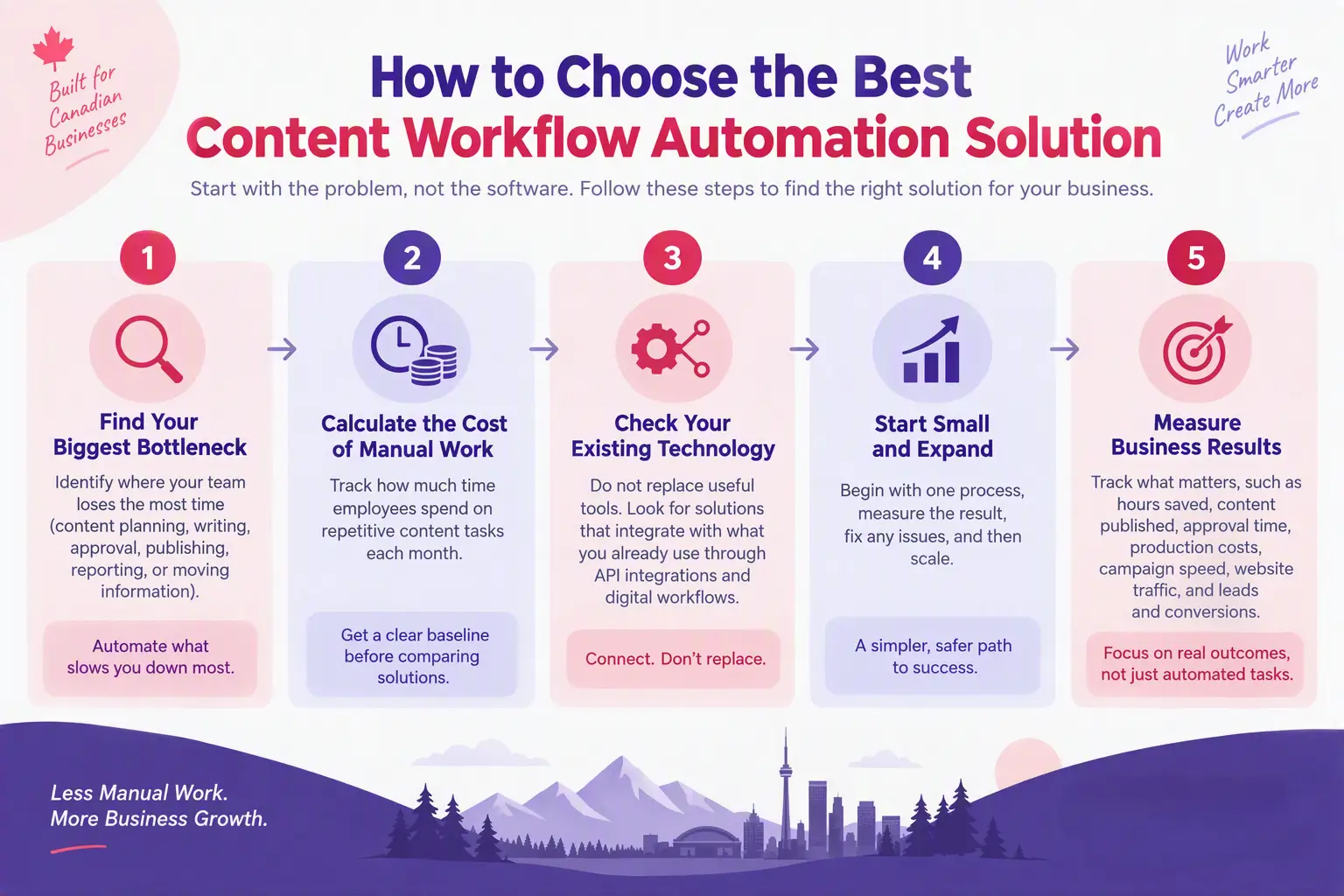
Before comparing the best content automation software for Canadian businesses, start with the problem rather than the software.
Ask your team where the most time is being lost.
Is it content planning? Writing? Approval? Publishing? Reporting? Moving information between platforms?
The answer should determine what you automate first.
Track how much time employees spend on repetitive content tasks each month.
This gives you a useful baseline when comparing affordable content workflow automation for SMBs.
Do not replace a useful system simply because a new automation platform has more features.
The better approach is often to connect the tools you already use through digital workflow automation and API integrations.
You do not need to automate the entire marketing operation on day one.
Start with one process, measure the result, fix problems, and then expand.
This is often the safest approach to how Canadian SMBs can automate content workflows without creating unnecessary complexity.
Track more than the number of automated tasks.
Useful measures include:
Automation should improve business productivity, not simply make a workflow look more technical. Measuring the right outcomes also means understanding content reach & impressions in digital marketing
The choice between software and custom automation depends on the business.
Standard software is often a good starting point for companies with common content processes. It can be quicker to deploy and easier to budget.
Custom automation makes more sense when workflows are unique, several business systems need to communicate, or the company needs more control over how work moves between departments.
For many SMBs, the best approach is a combination: use reliable content automation software where it fits, then add custom business workflow automation where standard tools fall short. The same trade-off is explored in in-house digital marketing vs hiring an agency.
Automation can create problems when the underlying process is unclear.
Do not automate a broken workflow simply because it is repetitive. First simplify the process.
Do not rely entirely on AI-generated content without human review. AI can speed up production, but people still need to check accuracy, tone, brand standards, and useful local context. This is a recurring theme in the ethics of AI: balancing innovation with responsibility.
Avoid adding too many disconnected tools. A growing collection of automation platforms can create more work instead of less.
Finally, do not measure success only by how many tasks were automated. The real question is whether the business is saving time, improving quality, publishing consistently, and generating better results.
The biggest benefit is not automation itself. It is the time and consistency gained from a better process.
Businesses can reduce repetitive work, speed up approvals, improve team collaboration, maintain a stronger publishing schedule, and make content production easier to manage.
For small marketing teams, content marketing automation can also help connect planning, production, distribution, and reporting.
Yes, when the business has repeatable processes that consume significant staff time.
A company publishing a few pieces of content a month may need only simple automation. A growing company managing blogs, social media, email campaigns, landing pages, and multiple approval stages may gain much more from a connected workflow.
The important point is to automate the right work.
There is no single price for content workflow automation.
Costs depend on whether you use software, integrations, custom development, AI services, or a combination of these.
A basic workflow may need only a few automated steps. A larger content automation platform Canada project may connect CRM, CMS, analytics, marketing, AI, and internal systems.
For this reason, businesses should compare total implementation and maintenance costs rather than looking only at a monthly software fee.
A good solution should be easy enough for the team to use, flexible enough to support current workflows, and scalable enough for future growth.
Look for:
The right content workflow management software should fit the way your business operates instead of forcing your team into an unnecessarily complicated process. For teams also managing customer data, choosing the right CRM for your business is a useful parallel decision.
Yes, but AI should be one part of the workflow.
AI can help with drafting, summarization, classification, content repurposing, text analysis, recommendations, and other repetitive tasks.
This supports an important point for SMBs: AI is becoming part of broader business processes, not just content writing.
The best content automation solutions combine AI with clear rules, human review, workflow management, and useful integrations.
The best solution depends on the company’s workflow, content volume, existing technology, budget, and growth plans.
A small business may need a simple automation setup. A growing marketing team may benefit from connected content workflow software. A company with complex systems may need content workflow automation services for SMBs or custom development.
For Canadian businesses, the right question is not simply, “Which platform has the most features?”
A better question is:
“Which workflow is costing our team the most time, and what is the simplest reliable way to automate it?”
That approach keeps automation focused on business value. It also aligns with broader priorities like digital marketing for small business: where to start as an entrepreneur in Canada.
The best Content Workflow Automation Solutions are not necessarily the most advanced or expensive. They are the ones that remove meaningful manual work from a company’s daily operations.
For Canadian SMBs, the strongest starting point is usually a repeatable process with a clear bottleneck. That could be content approvals, publishing, task assignment, reporting, or moving information between marketing systems.
Start with one workflow. Measure the time and effort it takes today. Automate the repetitive steps, keep human review where it matters, and then expand the system as your business grows.
AI can make these workflows more capable, but good process design still comes first. When content automation for small businesses is built around real business needs, it can improve productivity without making the operation harder to manage.
If your Canadian business is spending too much time on repetitive content tasks, Let’s Nurture can help you identify practical automation opportunities and connect the systems your team already uses.