

ai-mirror-for-ecommerce-increase-online-sales

AI Mirror: How Ecommerce Brands Increase Online Sales

20 Jul. 26
11 VIEWS

Shopping online has always come with one big question: Will this actually look good on me? AI Mirror helps answer that by letting people see products on themselves before they buy. The result? More confident shoppers, higher sales, and fewer returns for ecommerce brands.

In this guide, I’ll explain what an AI Mirror is, how it works, why more ecommerce brands are using it, and how your business can use it to boost online sales while cutting down on product returns.

What Is an AI Mirror and How Does It Increase Ecommerce Sales?

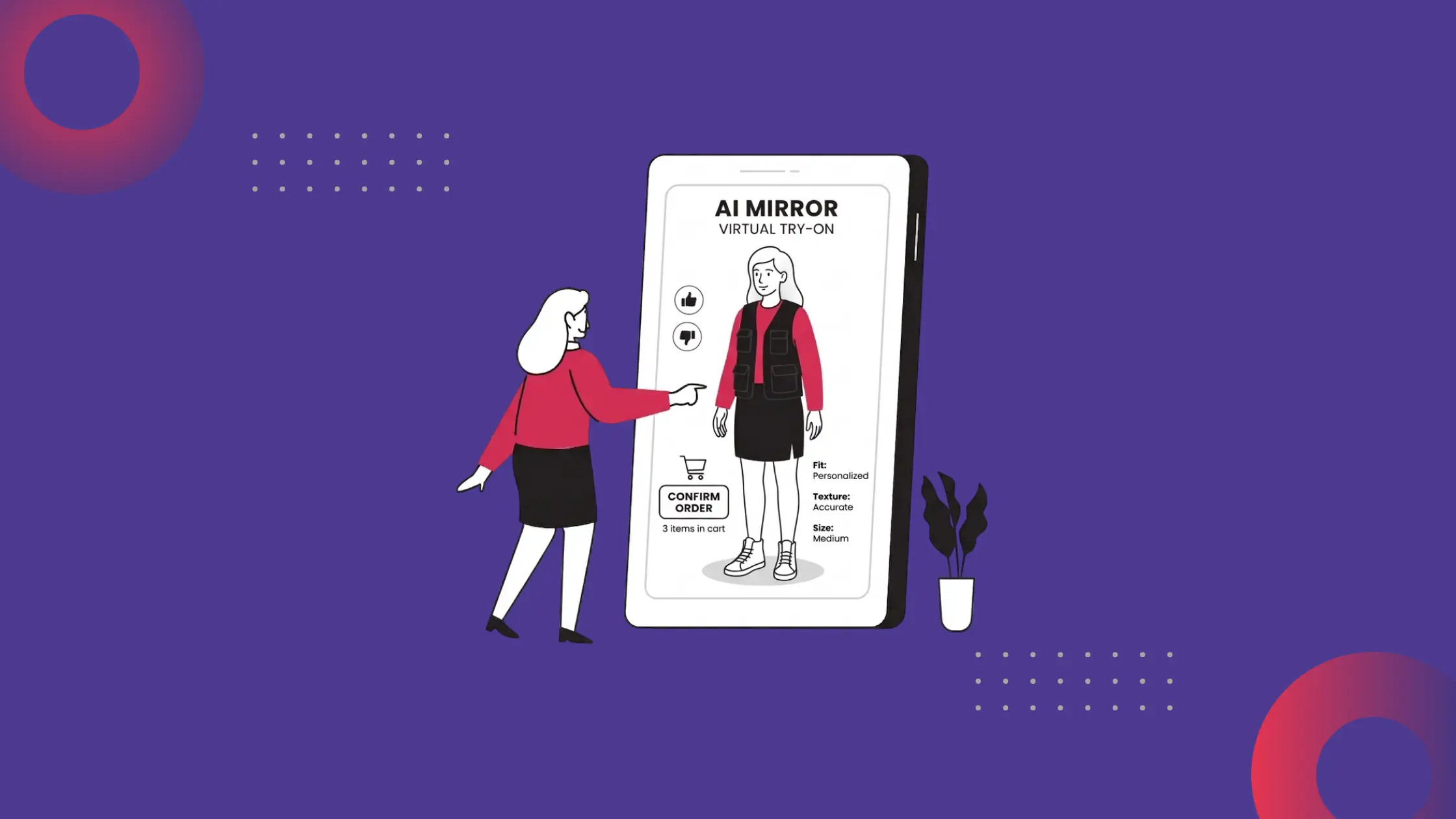
An AI Mirror is a virtual shopping tool that lets customers see how a product looks on them before they buy it. They can use their phone or laptop camera, or upload a photo, to try on products like glasses, makeup, jewelry, watches, clothing, and even hairstyles without visiting a store.

For ecommerce brands, this solves one of the biggest reasons people leave without buying: uncertainty. When shoppers can actually see themselves wearing a product, they’re usually more confident about hitting the Buy Now button. That often leads to higher conversion rates, fewer abandoned carts, and fewer returns because customers know what to expect before placing an order.

How AI Mirror Technology Works

Behind the scenes, several AI technologies work together in just a few seconds to create a realistic virtual try-on experience. These include:

  • Computer Vision
  • Facial Detection
  • Body Landmark Recognition
  • Image Processing
  • Real-Time Product Visualization

When someone opens the AI Mirror, the software first identifies important facial features or body points, depending on the type of product they’re trying. It then places the digital product in the right position and keeps it aligned as the person moves. The system also adjusts for things like lighting, camera angle, distance, and proportions so the product looks as natural as possible.

Today’s AI Mirror software goes a step further than virtual try-ons. Many platforms learn from browsing history, past purchases, favorite colors, face shape, or personal style to recommend products customers are more likely to buy. Instead of showing the same suggestions to everyone, the shopping experience feels much more personal.

Some ecommerce brands also combine AI Mirrors with AI shopping assistants. While customers are trying on a product, the assistant can recommend matching accessories, similar styles, or complementary items. That makes shopping easier for customers and creates more opportunities for brands to increase average order value through natural cross-selling.

AI Mirror vs Traditional Product Images

For years, ecommerce stores have relied on product photos to sell online. The problem is that even the best photos can’t answer the question most shoppers have before buying.

“Will this actually look good on me?”

That’s where an AI Mirror makes a real difference.

Here’s the difference.


Traditional Product ImagesAI Mirror
Static product photosLive, interactive product preview
Customers have to imagine how it will lookCustomers can see the product on themselves
Same experience for everyonePersonalized virtual try-on
More uncertainty before buyingGreater confidence when making a purchase
Passive browsingInteractive shopping experience
Higher chance of returnsBetter-informed buying decisions


Traditional product images only answer one question:

“What does the product look like?”

An AI Mirror answers the question shoppers actually care about:

“What will it look like on me?”

It might sound like a small difference, but it’s often the deciding factor between someone leaving your website and completing their purchase. When customers can see themselves wearing or using a product, they spend less time guessing and more time buying with confidence.

AI Mirror for Ecommerce Industries

AI Mirrors first became popular in the fashion industry, but that’s no longer where they stop. Today, ecommerce businesses across different sectors are using AI-powered virtual try-on technology to make online shopping more interactive and give customers the confidence to buy without second-guessing their choices.

1. AI Mirror for Fashion Ecommerce

Fashion is where AI Mirrors have made the biggest impact. One of the biggest challenges with buying clothes online is that customers can’t tell how an outfit will actually look on them. Product photos and size charts only go so far.

With an AI Mirror, shoppers can virtually try on outfits, compare colors, and see different styles on themselves before making a purchase. Many fashion brands also use Virtual Dressing Rooms and Digital Fitting Rooms to reduce uncertainty, improve conversions, and cut down on returns.

2. AI Mirror for Beauty Brands

Beauty products are highly personal, and customers usually have plenty of questions before they buy.

  • Will this lipstick match my skin tone?
  • Is this foundation the right shade?
  • Which eyeshadow works best for me?

Instead of guessing, shoppers can see the products on their own face in real time. That makes choosing the right shade or style much easier and gives customers more confidence to place an order. To see how leading beauty companies are using this technology to improve customer engagement and increase online sales, read our guide on How Smart Mirrors are Revolutionizing the Beauty Industry With AI and AR

3. AI Mirror for Eyewear Stores

Buying glasses online isn’t easy because the right frame depends on face shape, size, and personal style.

An AI Mirror lets customers try on multiple frames in just a few clicks, switch between styles, and compare different looks before deciding. It’s a much better experience than scrolling through dozens of product photos and hoping for the best.

4. AI Mirror for Jewelry Ecommerce

Jewelry is often an emotional purchase, especially when customers are buying premium pieces or gifts. Before spending more, they want to know exactly how a necklace, ring, bracelet, or pair of earrings will look.

An AI Mirror helps remove that uncertainty by giving shoppers a realistic preview, making it easier to buy with confidence.

5. AI Mirror for Accessories

AI Mirrors aren’t limited to clothing and beauty products. They’re also being used for accessories like watches, handbags, hats, scarves, and sunglasses.

Customers can mix and match different items, experiment with complete looks, and see what works together before checking out. That makes shopping more enjoyable while also encouraging larger orders through natural product recommendations.

Why Ecommerce Brands Need AI Mirror

Getting people to visit your website is only half the battle. The harder part is giving them enough confidence to actually place an order.

If you run an ecommerce store, you’ve probably seen this happen countless times.

A shopper lands on a product page, spends a few minutes looking through different options, checks reviews, compares colors or styles, and even adds something to the cart.

Then they leave.

Most of the time, it isn’t because the price is too high.

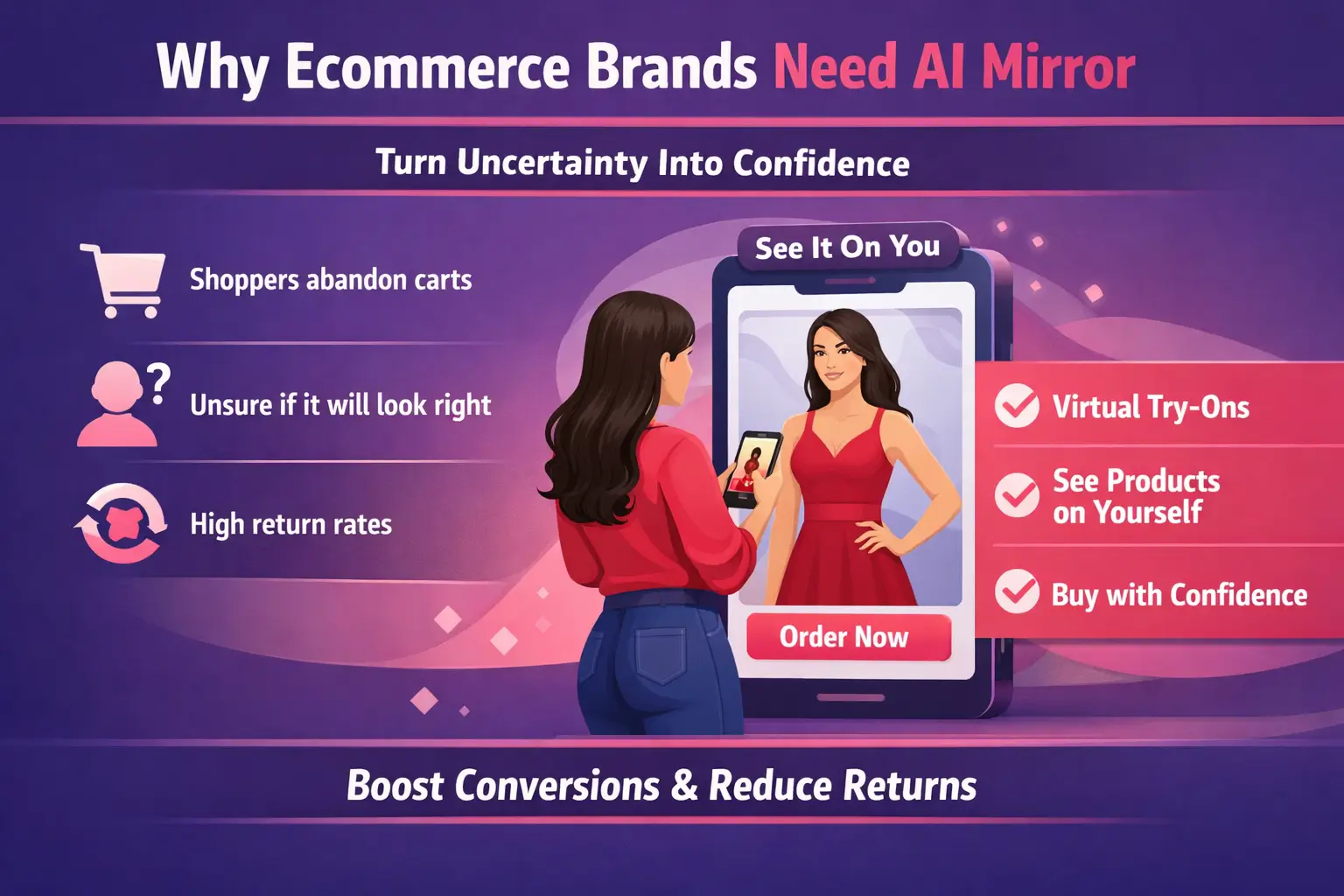
It’s because they’re still not sure.

They wonder if the product will look good on them. They question whether the color will match what they expect. They worry about the fit, the style, or whether they’ll end up returning it.

That hesitation is one of the biggest reasons online stores lose sales every day.

An AI Mirror helps remove that uncertainty. Instead of asking customers to imagine how a product might look, it lets them see it on themselves before they buy. When shoppers feel more confident in their decision, they’re far more likely to complete the purchase—and much less likely to regret it afterward.

AI Mirror Solves One of Online Shopping’s Biggest Problems

One thing online shopping still can’t fully replace is the experience of trying a product before you buy it.

When people shop in a physical store, they naturally do things that help them make a decision. They try on clothes, put on different pairs of glasses, compare jewelry, test makeup, or simply ask a friend, “How does this look?”

Online shopping takes away most of those moments.

That’s why so many customers hesitate before clicking Buy Now. They’re not always questioning the price—they’re wondering whether the product will actually suit them.

An AI Mirror brings much of that missing confidence back. Instead of asking shoppers to imagine the outcome, it lets them see the product on themselves before placing an order.

It sounds like a small change, but it has a big impact. When customers can visualize the product on themselves, they’re more comfortable making a purchase and far less likely to second-guess their decision.

Customer Expectations Have Changed

Today’s shoppers don’t just compare your website with another ecommerce store. They compare it with the best online experiences they’ve ever had, whether that’s Amazon, Sephora, Nike, or any brand that makes shopping quick, personal, and effortless.

They’ve come to expect things like:

  • Personalized product recommendations
  • Interactive shopping experiences
  • Fast, mobile-friendly browsing
  • Realistic product previews
  • A smooth checkout process
  • A consistent experience across every device

If your website still relies only on static product photos, it can feel dated compared to what customers see elsewhere.

An AI Mirror platform helps close that gap by making shopping more personal and interactive. Instead of showing every visitor the same product page, it gives each customer a chance to see how products look on them, making the experience feel far more relevant—and making it easier to move from browsing to buying.

A shopper using an AI Mirror to visualize products and boost online sales

Why Traditional Ecommerce Experiences Don’t Convert Like They Used To

Online shopping isn’t what it was a few years ago. Customers have more choices than ever, and switching to another store takes just a few seconds.

That means people are less willing to take chances. If they’re unsure about a product, they usually won’t spend time thinking about it—they’ll leave and look somewhere else.

You see this most often in industries like fashion, beauty, eyewear, and accessories, where appearance plays a huge role in the buying decision. A few product photos and a size chart aren’t always enough to convince someone to buy.

That’s where an AI Mirror changes the experience.

Instead of asking customers to picture how a product might look, it lets them see it on themselves before they place an order. That extra confidence can make all the difference between someone abandoning their cart and completing the purchase.

For ecommerce brands, the benefits often show up across the entire customer journey:

  • Higher conversion rates
  • Longer time spent on the website
  • Better customer engagement
  • More repeat purchases
  • Fewer product returns
  • Stronger trust in the brand

Many ecommerce businesses spend more every year trying to bring new visitors to their website. But getting more traffic isn’t always the biggest opportunity. In many cases, helping the people who are already on your site feel confident enough to buy delivers a much better return on investment.

How an AI Mirror Helps Increase Online Sales

Bringing people to your website is only part of the job. The real challenge is convincing them to buy.

Every ecommerce brand invests in attracting visitors through SEO, paid ads, email campaigns, or social media. Yet a large percentage of those visitors leave without placing an order. In many cases, the problem isn’t the product or even the price.

It’s uncertain.

People hesitate because they can’t picture how something will look on them. And when they’re unsure, they usually don’t buy.

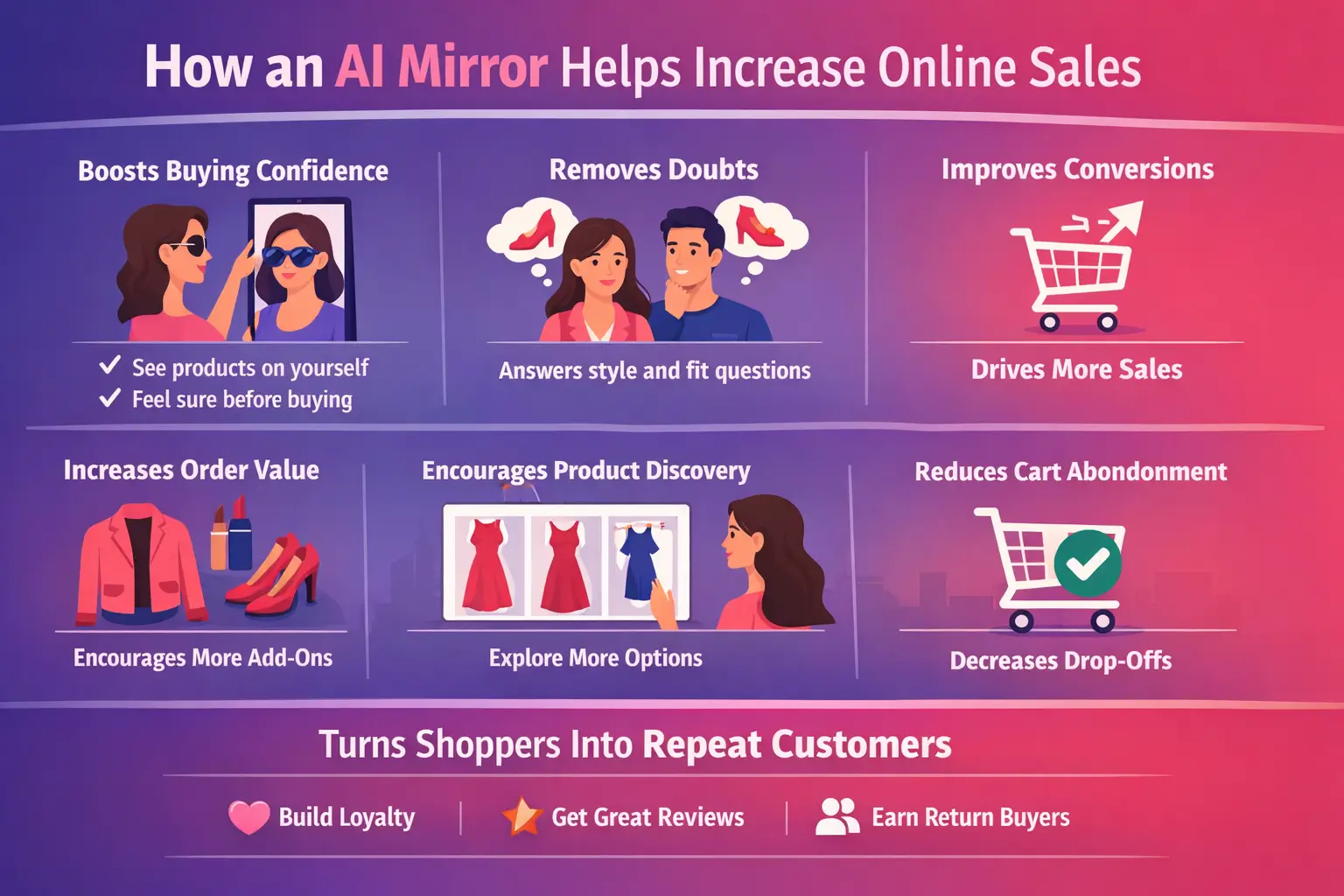
An AI Mirror helps remove that hesitation by letting shoppers see products on themselves before they make a decision. That one change can have a noticeable impact on the way people shop.

Here are some of the biggest ways ecommerce brands use AI Mirrors to increase online sales.

1. It Gives Customers the Confidence to Buy

Confidence plays a bigger role in online shopping than most people realize.

Imagine you’ve found a pair of sunglasses you like. The price is fine, the reviews look good, but you’re still wondering whether the frames suit your face. Rather than taking the chance, you close the tab and think, “I’ll come back later.”

Most shoppers never do.

With an AI Mirror, there’s no need to guess. Customers can try on different styles, compare options, and see what looks best before they commit. Once that uncertainty disappears, buying becomes a much easier decision.

2. It Removes the Little Doubts That Stop Sales

Most abandoned purchases don’t happen because of one major issue. They happen because of several small questions that never get answered.

  • Will this color suit me?
  • Is this the right size?
  • Are these glasses too wide for my face?
  • Will this necklace look too big?

If shoppers can’t answer those questions, they often leave to keep researching—or they simply decide not to buy.

An AI Mirror answers many of those questions instantly, so customers can keep moving toward checkout instead of second-guessing every decision.

3. It Improves Conversion Rates

Higher conversion rates usually come from removing friction, not adding more sales tactics.

One of the biggest barriers in ecommerce is uncertainty. When shoppers can interact with products instead of only looking at photos, they’re naturally more confident about what they’re buying.

Retailers that have introduced virtual try-on experiences have reported better engagement, higher conversion rates, and stronger purchase confidence, especially in categories like fashion, beauty, and eyewear.

The goal isn’t to pressure customers into buying. It’s to help them make a decision they feel good about.

4. It Increases Average Order Value

When customers feel confident about their first purchase, they’re often open to buying more.

Someone trying on a jacket might decide to add matching trousers. A shopper testing sunglasses may compare different frame colors before ordering an extra pair. Someone choosing a lipstick could also pick up a matching lip liner or skincare product.

Many AI Mirror platforms include AI-powered product recommendations that suggest complementary items while customers are already engaged. The recommendations feel helpful rather than pushy, making cross-selling much more natural.

5. It Helps Customers Discover More Products

Most ecommerce stores have products that customers never even see.

Interactive shopping changes that.

Instead of looking at one pair of glasses, shoppers might try five. Instead of stopping after two dresses, they may browse an entire collection just to see how each one looks.

The longer people explore, the more products they discover. For brands with large catalogs, that can increase revenue without spending more on advertising.

6. It Makes Online Shopping Feel More Interactive

A typical ecommerce journey is fairly predictable.

Browse a product.

Look through the photos.

Read the description.

Leave.

An AI Mirror changes that routine by giving shoppers something to interact with instead of something to simply scroll past.

Trying on products, switching colors, and comparing different styles keeps people engaged for longer. It also creates a shopping experience that’s far more memorable — and one customer is more likely to share with friends or on social media.

7. It Helps Reduce Cart Abandonment

Cart abandonment is a problem every ecommerce business deals with.

Sometimes it’s because of shipping costs or payment issues. But quite often, shoppers abandon their cart because they’re still unsure about the product.

They wonder whether it will suit them, whether the fit will be right, or whether they’ll regret the purchase after it arrives.

An AI Mirror can’t eliminate cart abandonment completely, but it can remove many of those last-minute doubts. When customers feel more certain about what they’re buying, they’re naturally more likely to finish the checkout process.

8. It Turns First-Time Buyers Into Repeat Customers

Getting a sale is great.

Getting the same customer to come back again is even better.

When shoppers receive products that match what they expected, they’re more likely to trust the brand the next time they need something similar. That trust leads to repeat purchases, stronger customer loyalty, and better long-term value.

Happy customers also tend to leave positive reviews, recommend the brand to friends and family, and become loyal buyers over time.

For many ecommerce brands, that’s where an AI Mirror delivers its biggest value. It doesn’t just help increase today’s sales—it helps build lasting customer relationships.

How AI Mirror increases online sales and conversion rates for retail stores

How an AI Mirror Helps Reduce Product Returns

Returns are one of the biggest costs ecommerce brands deal with.

It’s not just the return shipping. Every returned order creates extra work for your team, ties up inventory, eats into profit margins, and sometimes leaves you with products that can’t be sold as new.

Fashion, beauty, jewelry, and accessories tend to see even higher return rates because customers are often buying based on photos alone. If the product doesn’t look the way they imagined, it’s likely coming back.

An AI Mirror helps tackle that problem before the order is ever placed.

1. Customers Get a Better Idea of What They’re Buying

The more clearly people can picture a product, the more confident they feel about buying it.

Instead of relying only on product photos, shoppers can use an AI Mirror to see how a dress, pair of glasses, lipstick, necklace, or other item looks on them. Seeing the product in a realistic setting makes it much easier to judge whether it’s the right choice.

That means fewer surprises when the package arrives.

2. It Closes the Gap Between Expectation and Reality

One of the most common reasons people return products is simple: what they received wasn’t what they expected.

You’ve probably seen return comments like these:

  • “It looked different online.”
  • “The color wasn’t what I expected.”
  • “The glasses didn’t suit my face.”
  • “It just wasn’t right for me.”

An AI Mirror helps narrow that gap by giving shoppers a personalized preview before they buy. The closer the online experience is to the real thing, the less likely customers are to regret their purchase.

3. It Reduces Style and Fit Uncertainty

An AI Mirror isn’t meant to replace a size guide, but it does answer questions that size charts can’t.

Customers can see how a style looks on them, whether a pair of glasses fits their face, how a necklace sits, or whether a particular outfit matches the look they’re going for.

When you combine that visual confidence with clear sizing information, shoppers can make much better buying decisions.

4. Happy Customers Are Less Likely to Return Products

A great ecommerce experience doesn’t end when someone clicks Buy Now.

It ends when the order arrives and the customer thinks, “This is exactly what I expected.”

That’s the experience every ecommerce brand wants to create.

When customers receive products that match what they saw online, they’re more likely to:

  • Leave positive reviews
  • Shop with you again
  • Recommend your brand to others
  • Feel confident about future purchases

That’s why many ecommerce businesses see an AI Mirror as more than a virtual try-on feature. It’s a way to set the right expectations before the sale, reduce avoidable returns, and build trust with every order.

Key Features to Look for in an AI Mirror

Not every AI Mirror delivers the same experience.

Some platforms offer realistic virtual try-ons that feel smooth and natural. Others feel slow, inaccurate, or difficult to use. If you’re comparing AI Mirror solutions, it’s worth looking beyond the feature list and focusing on what actually improves the customer experience.

Here are the features that matter most.

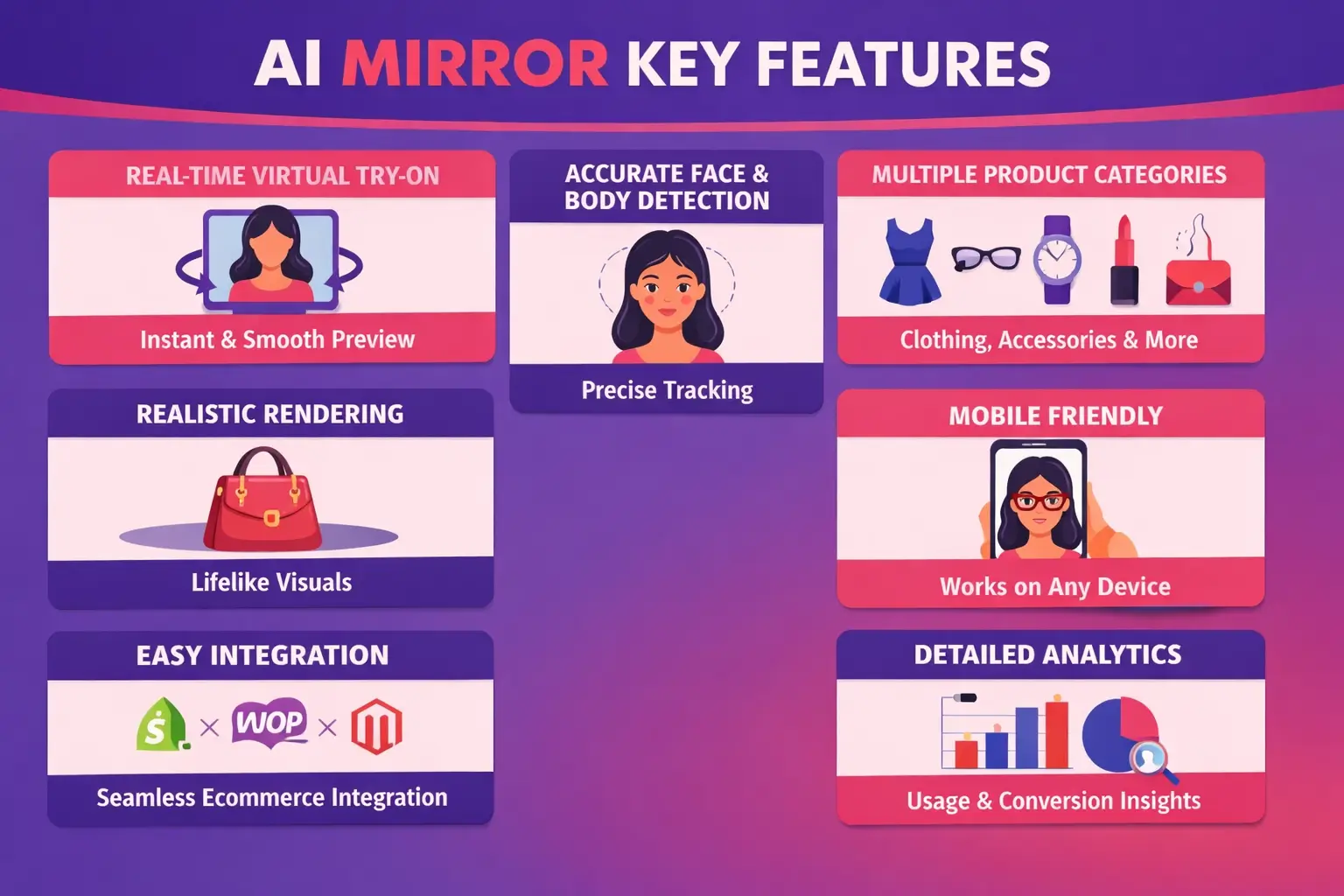
1. Real-Time Virtual Try-On

Nobody wants to wait for a product preview to load.

A good AI Mirror should respond almost instantly, allowing shoppers to switch products, move around, and see updates in real time. The smoother the experience feels, the more likely customers are to keep exploring instead of leaving the site.

2. Accurate Face and Body Detection

An AI Mirror is only as good as its accuracy.

If a pair of glasses sits in the wrong position or a necklace floats awkwardly, shoppers lose confidence almost immediately.

Look for a platform that uses reliable facial recognition and body landmark detection to keep products aligned naturally as customers move.

3. Support for Multiple Product Categories

Your needs today may not be the same a year from now.

Choosing a platform that supports multiple product categories gives you room to grow without switching technologies later.

Ideally, it should work across products such as:

  • Clothing
  • Glasses
  • Jewelry
  • Makeup
  • Watches
  • Fashion accessories

A flexible platform makes it easier to expand your virtual shopping experience as your product catalog grows.

4. Realistic Product Rendering

The best AI Mirrors don’t just place a product on the screen—they make it look believable.

Details like lighting, shadows, scaling, and positioning have a huge impact on how realistic the virtual try-on feels. When those details are done well, customers are much more likely to trust what they’re seeing.

5. A Mobile Experience That Works Just as Well

Most online shoppers browse and buy from their phones, so a desktop-only experience isn’t enough.

Your AI Mirror should load quickly, respond smoothly, and be easy to use on any screen size. If the mobile experience feels clunky or slow, many shoppers won’t stick around long enough to try it.

6. Easy Integration with Your Ecommerce Platform

Adding an AI Mirror shouldn’t mean rebuilding your entire website.

Look for a solution that integrates easily with the platform you already use, whether that’s:

  • Shopify
  • WooCommerce
  • Magento
  • A custom ecommerce platform
  • An enterprise commerce solution

The easier the integration, the faster you can launch without disrupting your existing store or customer experience.

7. Analytics That Go Beyond Virtual Try-Ons

A good AI Mirror doesn’t just improve the shopping experience—it also gives you valuable data about how customers shop.

Useful insights can include:

  • Which products are tried on most often
  • How long shoppers engage with virtual try-ons
  • Conversion rates after using the AI Mirror
  • Product interaction trends
  • Popular colors and styles
  • Overall shopping behavior

These insights can help your marketing, merchandising, and product teams make smarter decisions about inventory, promotions, and product recommendations.

AI Mirror vs. Virtual Try-On: What’s the Difference?

People often use AI Mirror and Virtual Try-On as if they mean the same thing, and they’re closely related. But there’s an important difference.

A Virtual Try-On is designed to do one thing well: let customers see how a specific product looks on them. Whether it’s a pair of glasses, lipstick, or a jacket, the focus is on giving shoppers a realistic preview before they buy.

An AI Mirror takes that experience a step further.

Along with virtual try-ons, it uses AI to create a more personalized shopping journey. Depending on the platform, it can recommend products based on a shopper’s preferences, suggest matching items, learn from browsing behavior, and deliver a more interactive experience from start to finish.

Think of it this way:

  • A Virtual Try-On is a feature.
  • An AI Mirror is a complete shopping experience built around that feature.

If your goal is simply to let customers preview products, a Virtual Try-On may be enough. But if you want to increase engagement, improve product discovery, personalize recommendations, and help shoppers buy with more confidence, an AI Mirror offers much broader capabilities.


FeatureAI MirrorVirtual Try-On
Product PreviewYesYes
AI PersonalizationYesLimited
Product RecommendationsYesUsually No
Customer AnalyticsYesLimited
Multi-Product ComparisonYesSometimes
AI Shopping AssistantYesRarely
Ecommerce PersonalizationAdvancedBasic
AI Customer ExperienceComprehensiveProduct-focused


In simple terms, Virtual Try-On is one capability, while an AI Mirror is a broader shopping platform designed to improve the entire customer journey.

Business Benefits of an AI Mirror

For most ecommerce businesses, the value of a new technology isn’t measured by how impressive it looks. It comes down to one question:

Does it help the business grow?

A well-designed AI Mirror can improve several parts of the customer journey at the same time, which is why many ecommerce brands see it as more than just another website feature.

Some of the biggest business benefits include:

  • Higher online conversion rates
  • More confident purchasing decisions
  • Fewer product returns
  • Increased average order value
  • Stronger customer loyalty
  • Better product discovery across your catalog
  • A more engaging digital commerce experience
  • A competitive advantage over brands still relying on static product pages
  • Support for long-term ecommerce innovation
  • A solid foundation for future AI-powered retail experiences

On their own, each of these improvements is valuable. Together, they can have a meaningful impact on revenue and profitability.

Instead of spending more every year to attract new visitors, ecommerce brands can get more value from the traffic they already have by making shopping easier, more interactive, and giving customers the confidence to buy.

How to Choose the Right AI Mirror Development Company

Adding an AI Mirror to your ecommerce store is about much more than installing new technology. It changes how customers interact with your products, how confident they feel while shopping, and how likely they are to complete a purchase.

That’s why choosing the right development partner is just as important as choosing the technology itself.

A good AI Mirror development company won’t just build the software. They’ll take the time to understand your products, your customers, your ecommerce platform, and the goals you’re trying to achieve.

Choose a Solution That Fits Your Business

No two ecommerce businesses sell the same way.

A fashion retailer has very different requirements from a jewelry brand. A beauty company needs different capabilities than an eyewear store. Trying to force every business into the same solution rarely delivers the best results.

Look for a development partner that offers a custom AI Mirror built around your products and customer journey instead of asking you to adapt your business to their software.

The more naturally the experience fits your store, the more likely customers are to use it—and the more value you’ll get from it.

Work with a Team That Understands AI and Ecommerce

Building an AI Mirror isn’t just about software development. It also requires experience with computer vision, machine learning, ecommerce workflows, and user experience.

When you’re evaluating different companies, ask questions like:

  • Have they built AI-powered ecommerce solutions before?
  • Do they have experience with computer vision and machine learning?
  • Have they worked with fashion, beauty, jewelry, or retail brands?
  • Can they share relevant case studies?
  • Do they provide ongoing support after launch?

A team with real-world experience is far more likely to anticipate challenges, avoid costly mistakes, and deliver a smoother implementation.

Make Sure It Integrates with Your Existing Store

The best AI Mirror is one that fits into your current ecommerce setup without creating unnecessary complexity.

Whether your store runs on Shopify, WooCommerce, Magento, or a custom ecommerce platform, integration should be straightforward and built to scale as your business grows.

A reliable development partner should also be able to connect the AI Mirror with your existing product catalog, inventory, analytics, and other business systems without disrupting day-to-day operations.

Don’t Overlook Performance, Security, and Scalability

Even the smartest AI Mirror won’t help if it feels slow or unreliable.

Customers expect virtual try-ons to load quickly, respond smoothly, and work just as well on a phone as they do on a desktop. A laggy experience can drive people away instead of encouraging them to buy.

Security matters just as much. Since customers may upload photos or use a live camera, your AI Mirror should follow strong privacy practices and protect user data throughout the entire experience.

It’s also worth thinking beyond today’s requirements. As your product catalog and customer base grow, the platform should be able to scale without needing a complete rebuild.

Look Beyond the Initial Cost

One of the first questions businesses ask is: How much does an AI Mirror cost?

The answer depends on several factors, including:

  • The types of products you sell
  • The number of SKUs
  • The complexity of the AI models
  • Your ecommerce platform
  • Custom features and workflows
  • Analytics and reporting requirements
  • Third-party integrations
  • Ongoing maintenance and support

While pricing is important, it shouldn’t be the only factor in your decision.

If an AI Mirror helps increase conversions, reduce product returns, improve customer retention, and grow average order value, the long-term return can far outweigh the initial investment. The right solution isn’t necessarily the cheapest—it’s the one that delivers measurable business results over time.

Common AI Mirror Implementation Challenges

Like any ecommerce technology, an AI Mirror isn’t something you simply switch on and forget about.

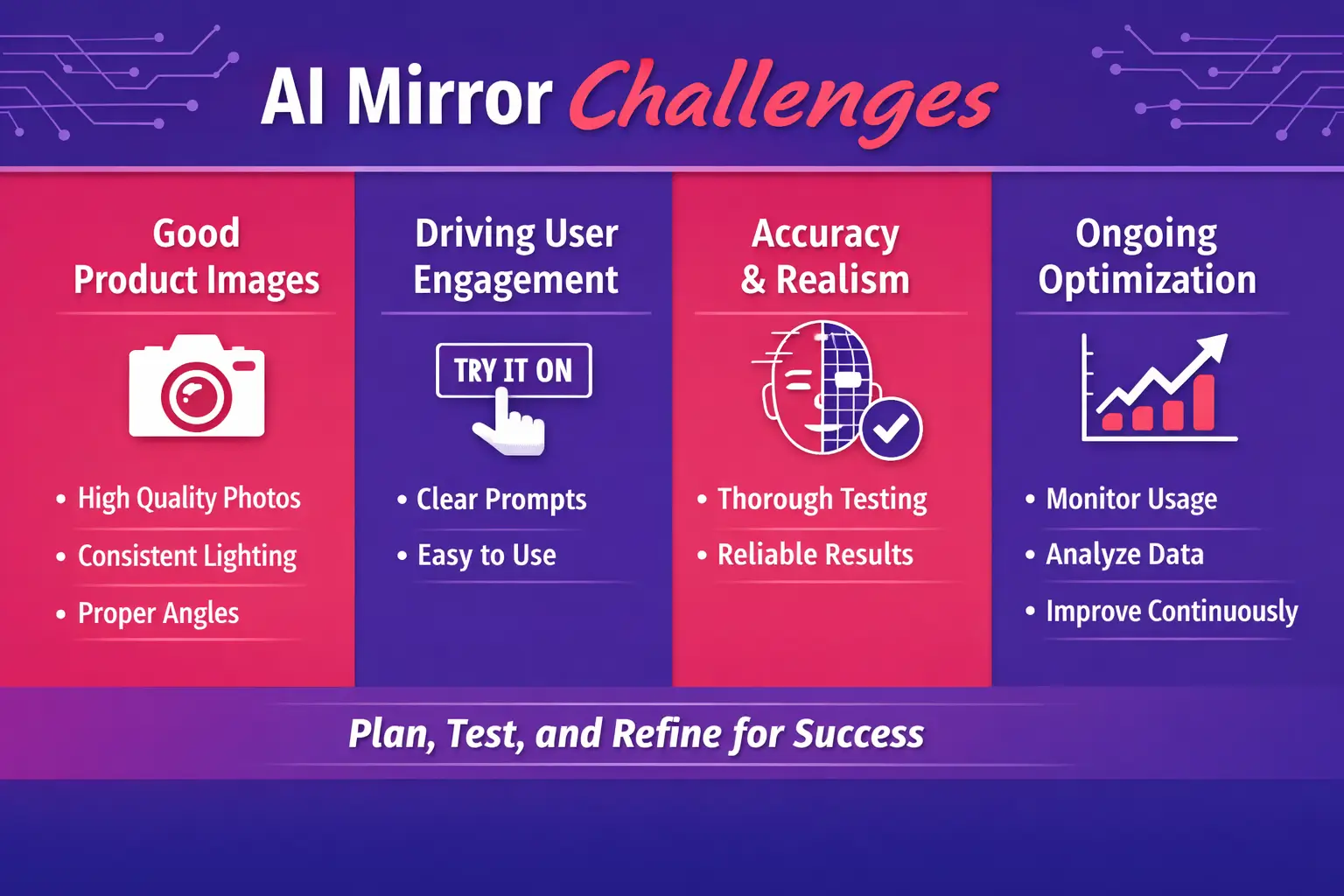
A successful implementation takes planning, testing, and a willingness to refine the experience over time. The good news is that most of the common challenges are predictable—and with the right approach, they’re completely manageable.

1. Good Product Images Make a Big Difference

Even the best AI Mirror performs better when it’s working with high-quality product images.

If photos have inconsistent lighting, awkward angles, or low resolution, the virtual try-on experience can look less realistic. Taking the time to standardize your product images before launch usually pays off with more accurate and believable previews.

Think of it as giving the AI better data to work with from the start.

2. Customers Need a Reason to Try It

Not every shopper will notice a new feature on their own.

Some people will jump straight into a virtual try-on, while others may need a little encouragement. Clear “Try It On” buttons, short instructions, and a simple first-time experience can make a big difference.

The easier it is to get started, the more likely customers are to use the feature—and once they do, they’re much more likely to see its value.

3. Accuracy Builds Trust

An AI Mirror only works if customers believe what they’re seeing.

If glasses don’t line up properly, makeup looks unnatural, or products appear to float instead of fitting realistically, shoppers will lose confidence quickly.

That’s why thorough testing is so important. Before launching, make sure the experience works well across different devices, cameras, lighting conditions, and real-world user scenarios. A little extra testing upfront can prevent a lot of frustration later.

4. Launch Is Just the Beginning

Adding an AI Mirror to your ecommerce store isn’t the finish line—it’s the starting point.

Once it’s live, keep an eye on how customers are actually using it. The data will usually tell you where the biggest opportunities are.

Pay close attention to:

  • How often shoppers use the AI Mirror
  • Conversion rates before and after virtual try-ons
  • Customer feedback and support requests
  • Product return rates
  • Which products generate the most engagement

Small improvements based on real customer behavior can add up over time. For many ecommerce brands, those ongoing refinements deliver just as much value as the initial launch itself.

The Future of AI Mirror

Online shopping is moving beyond simply helping people find products. The next step is helping them make better buying decisions with more confidence.

That’s where AI Mirror technology is heading.

As AI continues to improve, virtual shopping experiences will become faster, more accurate, and far more personalized. Instead of acting as a simple virtual try-on tool, AI Mirrors will become an important part of how people discover products, compare options, and decide what to buy.

Here’s what we can expect over the next few years.

AI Will Become Your Personal Stylist

Future AI Mirrors won’t just recommend individual products. They’ll be able to suggest complete outfits, matching accessories, and coordinated looks based on a shopper’s style, body type, previous purchases, and even seasonal trends.

Shopping will feel more like getting advice from a personal stylist than browsing an online catalog.

Smarter Product Recommendations

Today’s recommendation engines often highlight bestsellers or related products.

The next generation of AI shopping assistants will go much further. They’ll learn from customer preferences and shopping behavior to recommend products that genuinely match each person’s taste instead of showing the same suggestions to everyone.

A More Connected Shopping Experience

Customers already switch between phones, tablets, and laptops throughout the day. In the future, AI Mirrors will make those transitions seamless.

Someone might start trying on products on their phone during lunch, continue browsing on a laptop that evening, and even walk into a physical store where their saved virtual try-ons are ready to view.

The line between online and in-store shopping will continue to fade.

Even More Realistic Virtual Try-Ons

Advances in computer vision and generative AI are making virtual product previews look more natural every year.

As the technology improves, customers will see products with more accurate lighting, textures, proportions, and movement. That means fewer surprises after delivery and even greater confidence when shopping online.

AI Mirrors Will Become a Standard Ecommerce Feature

Not long ago, features like online payments, product search, and personalized recommendations were considered innovative. Today, customers simply expect them.

AI Mirrors are likely to follow the same path.

As the technology becomes more accessible, virtual try-ons and AI-powered shopping experiences will become a standard part of ecommerce rather than a premium feature offered by only a handful of brands.

Businesses that start investing now won’t just be adopting a new technology. They’ll be preparing for the way customers are likely to shop in the years ahead.

Why Partner with Let’s Nurture for AI Mirror Development?

The success of an AI Mirror project depends on more than the technology itself. It also depends on the team building it.

At Let’s Nurture, we work with ecommerce businesses to develop AI Mirror solutions that fit their products, customers, and business goals. Instead of offering a one-size-fits-all platform, we build solutions that integrate with your existing ecommerce ecosystem and deliver a shopping experience that feels natural for your customers.

Our expertise includes:

  • Custom AI Mirror development
  • AI and computer vision solutions
  • Ecommerce platform integration
  • Shopify, Magento, WooCommerce, and custom ecommerce development
  • Enterprise AI solutions
  • Performance optimization
  • Ongoing maintenance and technical support

Whether you’re launching an AI Mirror for the first time or improving an existing virtual try-on experience, our goal stays the same: build a solution that helps your customers shop with confidence while delivering measurable business results for your brand.

If you’re exploring how AI Mirror technology can fit into your ecommerce strategy, our team is ready to help you plan, build, and scale a solution that’s designed around your business—not the other way around.

Conclusion:

One of the biggest challenges in ecommerce has always been simple: customers can’t try a product before they buy it. That uncertainty influences everything from purchase decisions and cart abandonment to product returns and customer loyalty.

An AI Mirror helps remove much of that guesswork. When shoppers can see how a product looks on them before placing an order, they feel more confident in their decision. That confidence often leads to higher conversions, fewer returns, better engagement, and a shopping experience customers are more likely to come back to.

As online shopping continues to evolve, interactive and personalized experiences will become the norm rather than a nice-to-have feature. Brands that start investing in these technologies today will be in a stronger position to meet changing customer expectations tomorrow.

If you’re thinking about adding an AI Mirror to your ecommerce store, focus on more than the technology itself. The right solution should fit your products, your customers, and the way your business operates.

Contact us

At Let’s Nurture, we help ecommerce brands design, develop, and integrate custom AI Mirror solutions that deliver real business value—not just another feature on a product page. Whether you’re building a new online store or upgrading an existing one, our team can help you create a virtual shopping experience that turns more visitors into confident buyers.

Get in touch