


Contact us
Start with the process — not the technology — and choose an automation partner that can support your business from discovery through implementation and beyond.


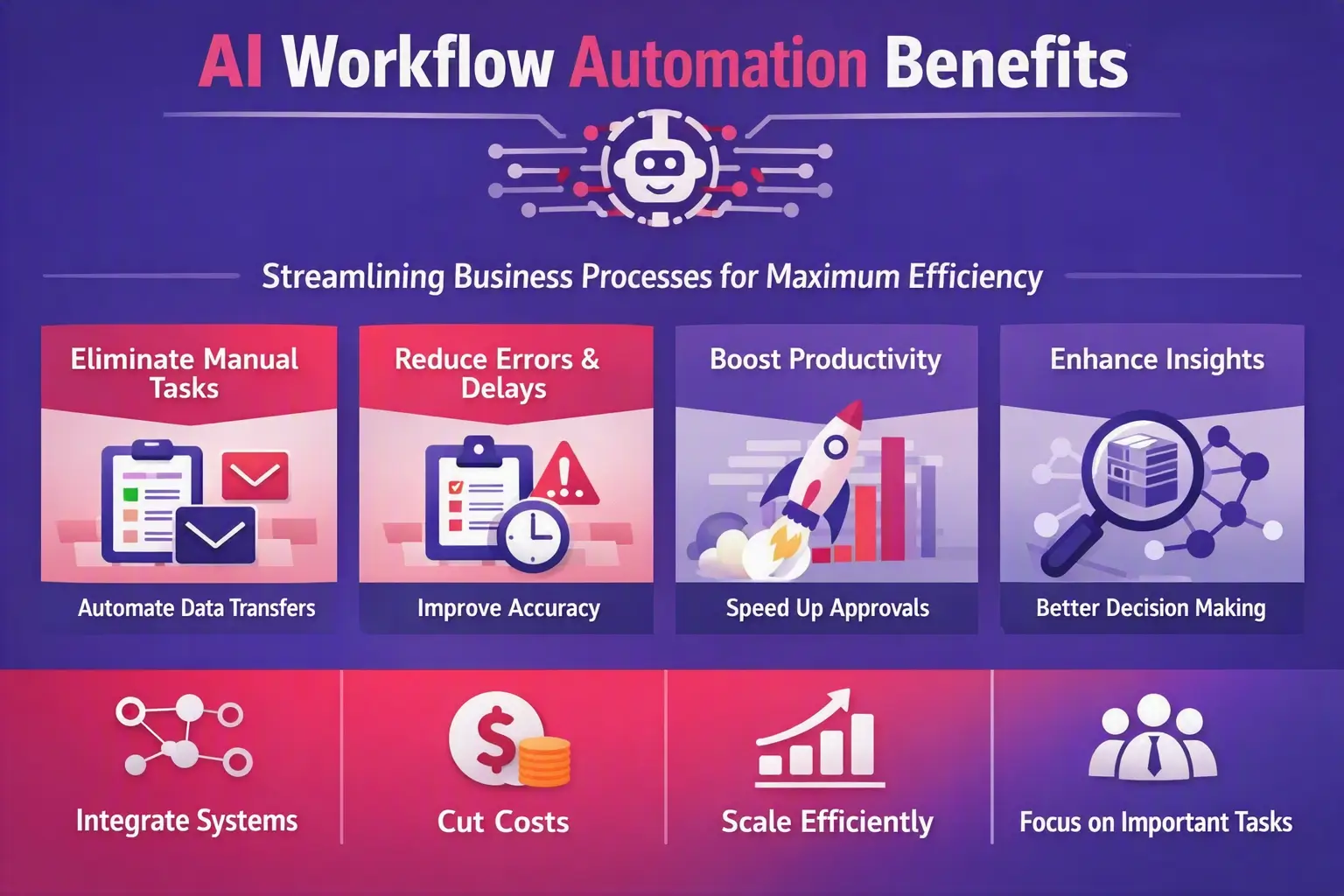
AI Workflow Automation Services help businesses reduce repetitive work, connect systems, improve productivity, and streamline complex processes. But choosing the right provider requires more than comparing prices or counting AI features.
The right partner should understand your business processes, integrate with your existing technology, protect your data, handle exceptions, scale with your growth, and prove that automation delivers measurable business value.
Choose AI Workflow Automation Services by evaluating a provider’s process expertise, AI capabilities, integrations, customization, security, scalability, implementation methodology, monitoring, support, and measurable ROI.
The best provider should first understand your existing workflow, identify where automation can create the most value, recommend the right combination of AI, APIs, RPA, rules, and human approvals, and then build a solution that can be monitored and improved over time.
In other words, don’t choose an automation provider because it has the most AI tools. Choose one that can solve your specific business problem reliably and profitably.
AI workflow automation combines artificial intelligence with business workflows to automate tasks that traditionally require manual effort.
Unlike simple rule-based automation, AI can work with information such as documents, emails, conversations, images, text, and other unstructured data.
For example, an automated workflow could:
AI Workflow Automation Services can include AI business process automation, document processing, data extraction, email automation, CRM automation, customer support automation, RPA, AI agents, API integrations, and workflow orchestration. For a deeper look into what RPA entails, check out our article on what you need to know about Robotic Process Automation (RPA).
The objective is not simply to “add AI.” The objective is to make business processes faster, more accurate, scalable, and easier to manage.
Many organizations still move information manually between emails, spreadsheets, CRM platforms, accounting systems, databases, helpdesks, and other applications.
That creates hidden costs.
Common problems include:
AI workflow automation can connect these processes so information moves automatically between systems while employees remain involved where human judgment is required.
Before discussing AI tools, ask the provider to understand how your business works today.
A good provider should examine:
This is important because automating an inefficient process can simply make an inefficient process run faster.
Ask:
Your provider should understand more than one automation approach.
Depending on the workflow, the solution may require:
A simple approval process may not need an AI agent. A document-processing workflow may benefit from AI, while a legacy application may require RPA.
The provider should explain why a specific technology is appropriate rather than forcing AI into every process.
Most businesses already have a technology stack.
Your automation should work with your existing systems whenever practical.
Ask whether the provider has experience integrating:
Strong integration capabilities reduce duplicate data entry and help information move consistently across departments.
Pre-built automation can work well for straightforward processes. Complex organizations often require custom AI workflow automation.
Custom solutions may include:
Ask whether the provider can modify the workflow when your business changes.
A good automation partner should build around your process rather than forcing your business to adapt to a rigid template.
AI models can differ in cost, speed, accuracy, capabilities, and suitability for specific tasks.
Ask your provider:
A strong provider should think about the long-term AI architecture rather than building a workflow that becomes expensive or difficult to maintain.
AI workflows may process customer information, financial records, contracts, employee information, or confidential business data.
Ask about:
For enterprise workflows, governance is particularly important. You should know who can access data, what actions the automation performed, and when those actions occurred. For businesses in regulated sectors, understanding compliance is key; explore our guide on understanding HIPAA and PIPEDA compliance for software.
AI should not necessarily make every decision independently.
For high-risk or uncertain situations, the workflow may need human approval.
Ask:
Human-in-the-loop automation can provide a practical balance between efficiency and control.
Launching an automation is not the end of the project.
You need to know whether workflows are actually working after deployment.
Ask whether the provider provides:
Without monitoring, a workflow can fail silently and create new operational problems.
Don’t evaluate providers only by their implementation quote.
Your total cost may include:
Ask the provider to estimate costs at different volumes.
For example, compare expected costs at today’s workload and at 2x or 5x your expected future volume.
This can reveal whether an apparently inexpensive solution will become expensive as your business grows.
Before committing to a large automation project, consider testing one high-value workflow.
A pilot can help you evaluate:
The pilot should have clear success criteria.
For example:
Current process: 4 hours of manual work per day
Target: Reduce manual effort by 60%
Measurement: Processing time, error rate, and number of manual interventions
A successful pilot gives you evidence before you scale automation across departments.
A workflow that works for 100 transactions may behave differently at 10,000 transactions.
Ask how the solution will handle:
Also ask what happens after launch.
Reliable AI Workflow Automation Services should include appropriate testing, deployment, monitoring, maintenance, updates, and support.
This is often overlooked when selecting an automation partner.
Ask:
A provider should make the long-term ownership model clear before development begins.
Before signing a contract, ask:
A provider that struggles to answer these questions clearly may not be ready to manage a production automation environment.
A good AI workflow automation company combines business understanding with technical expertise.
It should be able to explain:
The best partner is not necessarily the company offering the most complicated AI architecture.
It is the company that can build the simplest reliable solution that produces the desired business outcome.
There is no single price for AI Workflow Automation Services because costs depend on the complexity of the workflow.
Pricing can be influenced by:
Instead of asking only, “How much does automation cost?”, ask:
“How much will this automation cost compared with the manual process it replaces or improves?”
For example, if employees spend hundreds of hours each month performing repetitive tasks, the potential ROI may come from reducing that manual workload, accelerating processing, reducing errors, or increasing capacity.
Different organizations need different levels of automation.
AI workflow automation services for small businesses may focus on:
Growing companies may need automation across:
Enterprise AI workflow automation services may require:
AI workflow automation can be applied to many business processes, including:
The right use case is one where automation can produce a measurable improvement rather than simply adding another technology layer.
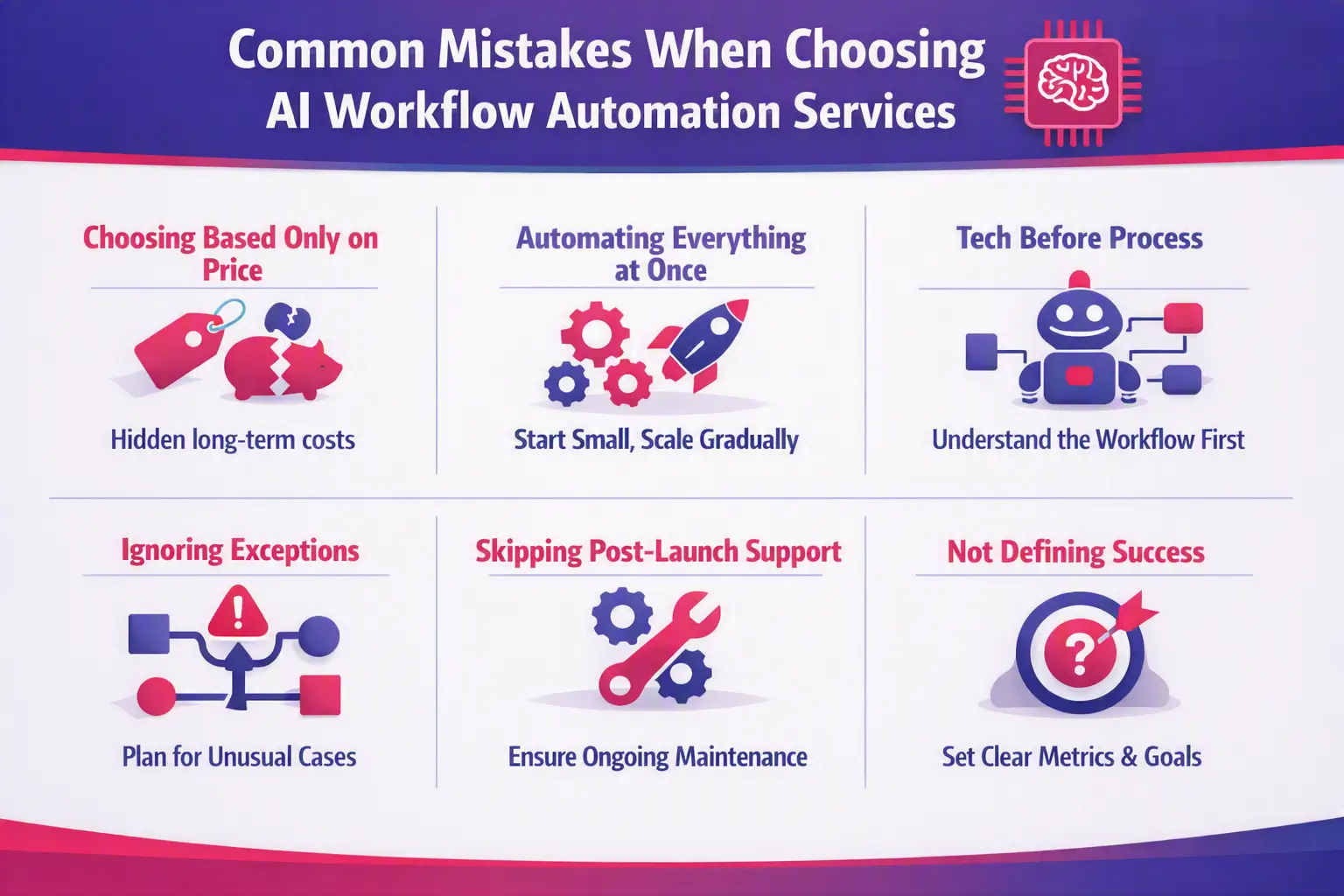
The cheapest solution may not be the cheapest long-term solution.
Integration problems, maintenance, failures, and poor scalability can increase the actual cost.
Start with one or two high-value processes. Prove the results and expand gradually.
A provider should understand the workflow before recommending an AI model, RPA platform, or automation tool.
Real business processes rarely follow one perfect path.
Your automation should account for unusual cases, missing information, failed integrations, and human approvals.
AI models, APIs, software platforms, business rules, and data can change.
Your automation needs ongoing monitoring and maintenance.
If you cannot measure the improvement, it becomes difficult to determine whether the automation was worth the investment.
Be cautious if a provider:
A trustworthy provider should be willing to discuss limitations as well as capabilities.
Use this checklist when comparing providers:
| Evaluation Area | What to Check |
|---|---|
| Business Understanding | Understands your process and goals |
| AI Expertise | Uses AI only where it adds value |
| Integrations | Connects your existing systems |
| Customization | Can adapt workflows to your requirements |
| Security | Protects business and customer data |
| Governance | Provides permissions and auditability |
| Human Oversight | Supports approvals and exceptions |
| Monitoring | Tracks workflow and AI performance |
| Scalability | Handles increased workload |
| TCO | Clearly explains long-term costs |
| Pilot | Offers practical validation |
| Support | Provides post-launch maintenance |
| Data Ownership | Clearly defines ownership and portability |
| ROI | Measures business outcomes |
You can also score each provider from 1 to 5 in every category and compare the total rather than relying on sales presentations alone.
Consider professional AI Workflow Automation Services when:
If you are looking to automate customer interactions specifically, understanding how to scale your business with AI chatbots can be a great starting point.
The right AI Workflow Automation Services provider should do much more than automate repetitive tasks.
Understanding AI Workflow Automation vs Traditional Automation can help you choose the right approach for your business. The right solution should help you understand your existing processes, identify high-value automation opportunities, combine AI with traditional automation where appropriate, connect your existing systems, protect your data, manage exceptions, monitor performance, and continuously improve your workflows.
The safest approach is to start with one high-value workflow, define clear success metrics, validate the solution through a pilot, and then expand automation based on proven results. You can learn more about how we approach this journey from initial experimentation to full-scale execution in our detailed guide on AI workflow automation: from experiment to execution.
If repetitive work is slowing your team down, Let’s Nurture can help assess your existing business processes, identify practical automation opportunities, and build AI-powered workflows around your specific requirements.
Start with the process — not the technology — and choose an automation partner that can support your business from discovery through implementation and beyond.


WhatsApp us