

ai-workflow-automation-vs-traditional-automation-key-differences

AI Workflow Automation vs Traditional Automation: Key Differences

06 Jul. 26
38 VIEWS

AI Workflow Automation vs Traditional Automation isn’t just about technology — it’s about choosing the right approach for your business. Learn the key differences, benefits, use cases, and how each solution supports business growth.

What is the difference between AI Workflow Automation and Traditional Automation?

The main difference between AI Workflow Automation and Traditional Automation is how they handle decisions. Traditional automation follows predefined rules to complete repetitive tasks and delivers the same result every time the conditions are met. AI workflow automation goes a step further by understanding context, analyzing both structured and unstructured data, and making decisions based on the information it receives. Traditional automation is best suited for predictable, rule-based processes, while AI workflow automation is a better choice for complex workflows that require flexibility, continuous learning, and smarter decision-making.

Businesses are investing more in automation to improve efficiency, reduce repetitive work, and help employees focus on higher-value tasks. According to Gartner, by 2028, around 33% of enterprise software applications are expected to include agentic AI, enabling autonomous decision-making for approximately 15% of daily work decisions. Deloitte also reports that organizations using AI-powered automation are achieving improvements in productivity, operational efficiency, and customer service. These trends show that business automation is moving beyond fixed, rule-based workflows toward systems that can understand context, adapt to changing situations, and support faster, more informed decisions.

What Is Traditional Automation?

Traditional automation uses predefined rules to automate repetitive business tasks. Every step follows a fixed set of instructions, so the process produces the same result whenever the defined conditions are met. Since it doesn’t learn or adapt on its own, it’s best suited for routine tasks with clear and predictable workflows.

A typical workflow follows simple logic:

If this happens ->  Perform this action

Since there is no learning or decision-making involved, traditional automation is ideal for stable and predictable processes.

Example

When a customer submits a contact form:

  1. Validate the form data.
  2. Create a CRM lead.
  3. Assign the lead to a salesperson.
  4. Send a confirmation email.

Every submission follows exactly the same workflow.

Key Features of Traditional Automation

  • Rule-based execution
  • Fixed workflows
  • Processes structured data
  • Fast and reliable execution
  • Consistent results
  • Easy to audit and maintain

Benefits

Traditional automation remains popular because it delivers measurable business value.

  • Reduces manual work
  • Saves time
  • Improves operational efficiency
  • Minimizes human errors
  • Standardizes business processes
  • Low implementation cost

Why Businesses Are Moving Beyond Traditional Automation

Traditional automation has helped businesses reduce manual work and improve efficiency for many years. However, today’s organizations manage far more than structured data. Customer emails, contracts, invoices, support tickets, chat conversations, and other unstructured information often require context and judgment that rule-based workflows can’t provide. AI workflow automation helps businesses process this information, understand what’s needed, and handle more complex tasks with less manual effort.

Limitations

Traditional automation has clear limitations.

  • Cannot learn from previous tasks
  • Cannot understand context
  • Struggles with emails, PDFs, images, and other unstructured data
  • Requires manual updates whenever business rules change
  • Limited flexibility for dynamic workflows

Common Use Cases

Traditional automation is ideal for repetitive administrative tasks such as:

  • Payroll processing
  • Invoice generation
  • CRM updates
  • Email notifications
  • Employee onboarding
  • Inventory updates
  • Appointment reminders
  • Report generation

Best suited for: Businesses with predictable workflows and structured data.

What Is AI Workflow Automation?

AI workflow automation combines automation with Artificial Intelligence to handle tasks that require analysis, understanding, and decision-making.

Instead of following fixed rules, it can analyze information, recognize patterns, understand natural language, and respond based on the context. This allows businesses to automate more complex processes that would normally require human involvement. 

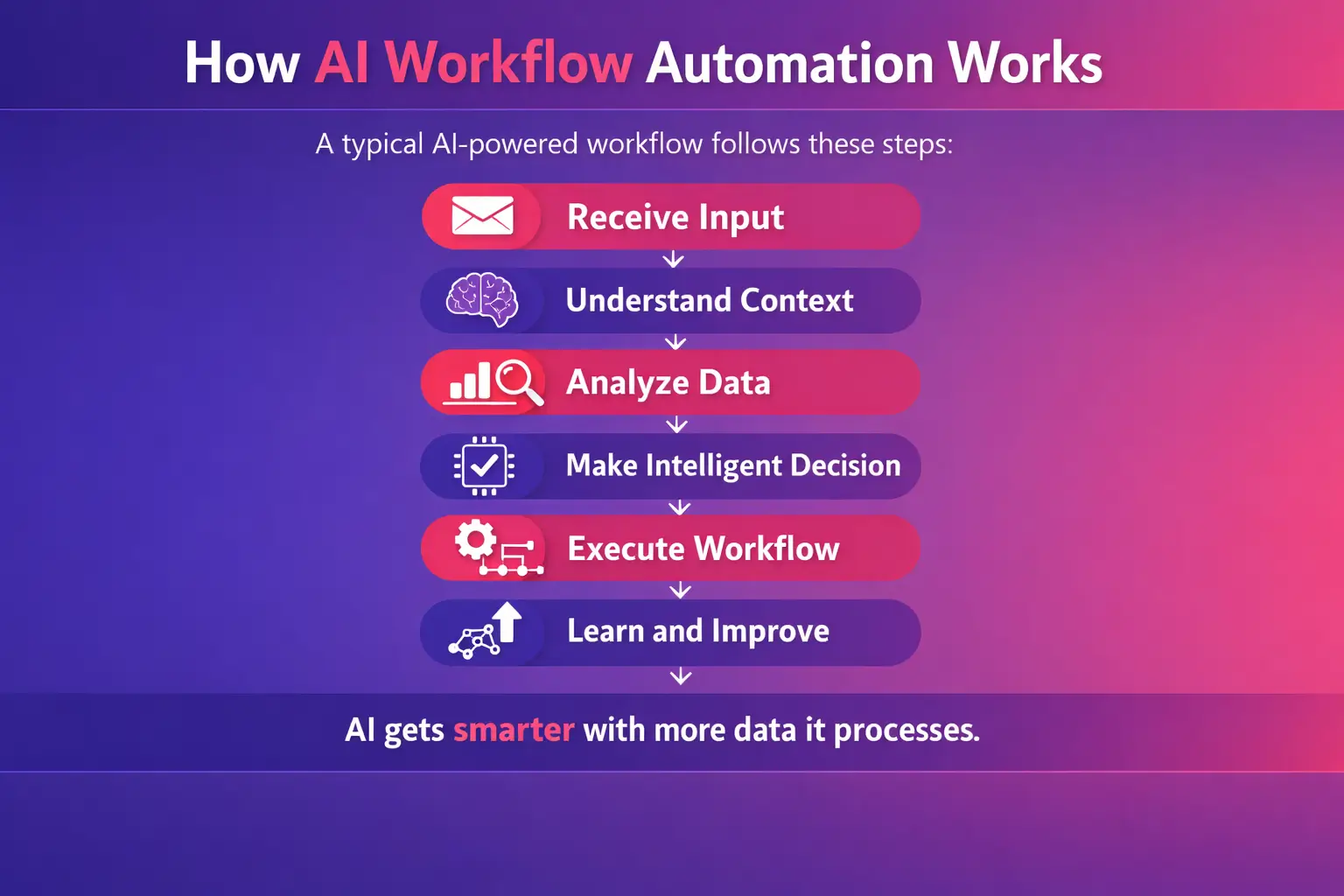
How AI Workflow Automation Works

Infographic showing how AI workflow automation processes data and makes intelligent decisions.

Key Features of AI Workflow Automation

Context-Aware Decision Making

AI understands the meaning behind information instead of matching predefined rules.

For example, it can recognize that two customer emails describe the same issue even if they use different wording.

Continuous Learning

Machine Learning enables AI systems to improve over time without requiring constant manual programming.

Intelligent Document Processing

AI can automatically process:

  • PDFs
  • Contracts
  • Invoices
  • Purchase orders
  • Emails
  • Forms

even when layouts vary.

Natural Language Understanding

AI understands human language, allowing businesses to automate:

  • Customer support
  • Email classification
  • Knowledge management
  • Internal help desks

Predictive Analytics

AI identifies patterns that help businesses:

  • Predict customer churn
  • Detect fraud
  • Forecast demand
  • Improve inventory planning
  • Identify operational risks

Dynamic Workflows

Unlike fixed workflows, AI adapts based on changing business conditions, reducing manual intervention.

How Generative AI Improves Workflow Automation

Modern AI workflow automation uses large language models (LLMs) and Generative AI to handle tasks such as summarizing documents, classifying requests, drafting emails, answering customer queries, and extracting information from contracts, invoices, and other unstructured content. By automating these time-consuming tasks, businesses can reduce manual effort, improve response times, and allow employees to focus on higher-value work.

Benefits of AI Workflow Automation

Organizations adopt AI workflow automation because it helps them:

  • Automate complex business processes
  • Improve decision-making
  • Increase productivity
  • Reduce operational costs
  • Enhance customer experiences
  • Process structured and unstructured data
  • Scale automation as the business grows

Business Impact of AI Workflow Automation

Example:

Organizations implementing AI workflow automation commonly experience:

  • Faster document processing
  • Reduced manual workload
  • Improved customer response times
  • Better compliance
  • Lower operational costs
  • Higher employee productivity
  • Faster business decisions

Common Business Applications

AI workflow automation is widely used across industries.

Customer Support

  • AI chatbots
  • Ticket routing
  • Sentiment analysis
  • Automated responses

Finance

  • Fraud detection
  • Loan processing
  • Risk assessment
  • Compliance monitoring

Human Resources

  • Resume screening
  • Candidate matching
  • Employee onboarding

Marketing & Sales

  • Lead scoring
  • Personalized campaigns
  • Customer segmentation
  • Revenue forecasting

Healthcare

  • Medical document analysis
  • Appointment scheduling
  • Insurance claim processing

Best suited for: Businesses managing dynamic workflows, customer interactions, and large volumes of unstructured data.

AI Workflow Automation vs Traditional Automation

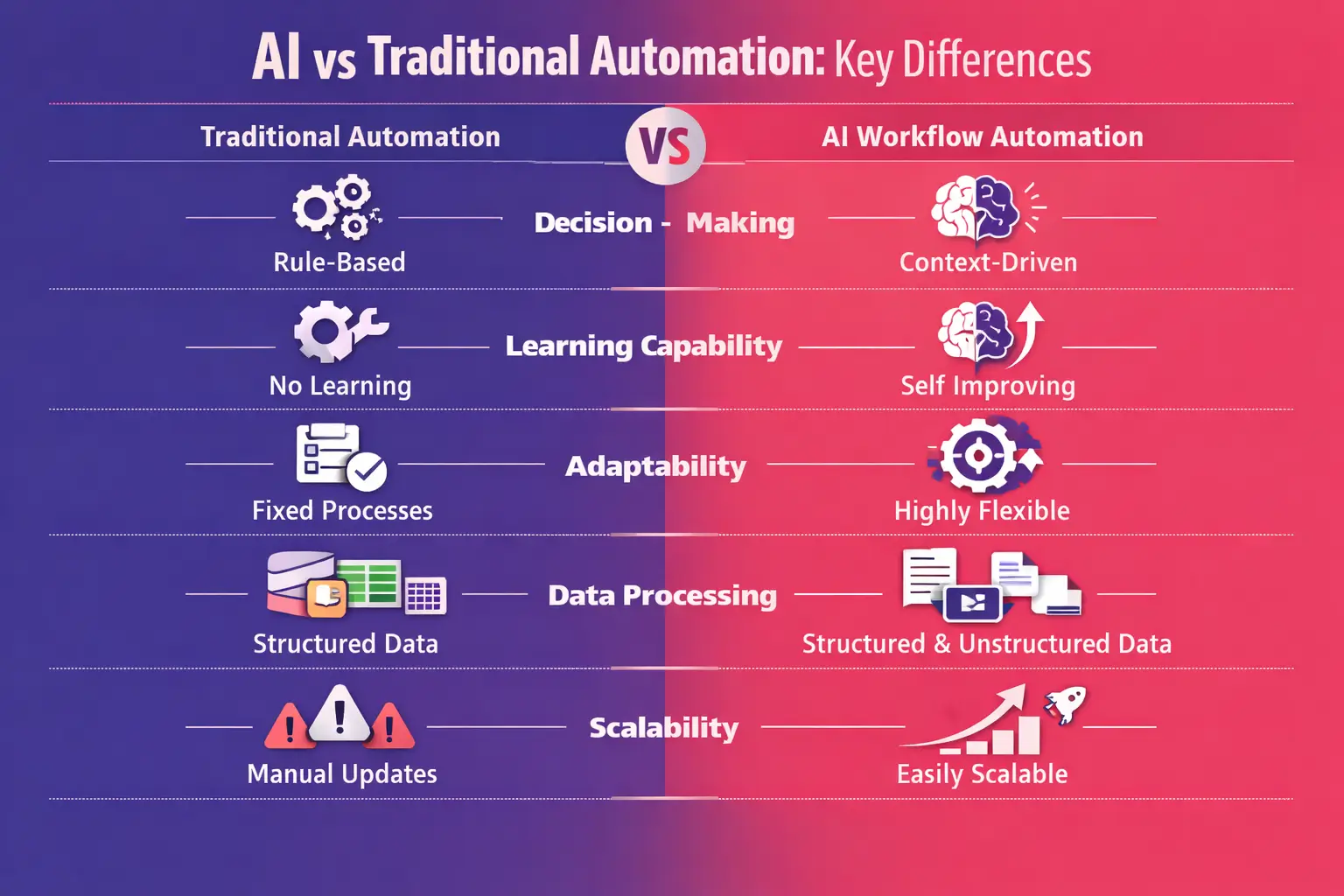
FeatureTraditional AutomationAI Workflow Automation
Decision MakingRule-basedContext-aware
LearningNoYes
AdaptabilityFixed workflowsDynamic workflows
Data ProcessingStructured dataStructured & unstructured data
Error HandlingStops on exceptionsHandles many exceptions intelligently
ScalabilityRequires more rulesLearns and scales over time
MaintenanceManual updatesContinuous improvement
Best ForRepetitive tasksComplex business processes


Traditional automation follows predefined rules to complete repetitive tasks, while AI workflow automation can analyze information and respond based on the situation. For many businesses, the best approach is to use both together — traditional automation for routine, rule-based processes and AI workflow automation for tasks that require context, flexibility, and more informed decision-making.

Cost Comparison:

FactorTraditional AutomationAI Workflow Automation
Initial CostLowerHigher
MaintenanceMediumLower over time
ScalabilityModerateHigh
ROIMediumHigh (long-term)


Although AI workflow automation may require a higher initial investment than traditional automation, it can provide greater long-term value by reducing manual work, improving operational efficiency, and adapting more easily as business needs change.

Key Differences Between AI Workflow Automation and Traditional Automation

Both AI workflow automation and traditional automation help businesses automate processes, but they are designed for different types of work. Understanding how they differ will help you choose the approach that best fits your business needs.

1. Decision-Making

Traditional automation follows a fixed set of rules, so every step and possible outcome must be defined before the workflow runs.

AI workflow automation works differently. It analyzes the available information, considers the context, and responds based on the situation. This makes it a good choice for workflows such as approval processes, customer support, document handling, and other tasks that require more flexibility than rule-based automation can provide.

2. Learning Capability

Traditional automation performs the same task in the same way until someone updates the workflow or changes the rules.

AI workflow automation can improve over time by learning from previous data and user interactions. As it processes more information, it becomes better at handling similar tasks with greater accuracy and consistency.

3. Adaptability

Traditional automation works best when business processes stay consistent and follow the same set of rules over time..

AI workflow automation is more flexible, allowing it to adjust to changing business requirements, customer requests, and different types of documents without requiring frequent updates to the workflow.

4. Data Processing

Traditional automation is designed for structured data such as:

  • CRM records
  • ERP systems
  • Excel spreadsheets
  • Online forms

AI workflow automation can process both structured and unstructured data, including:

  • Emails
  • Contracts
  • PDFs
  • Images
  • Chat conversations
  • Customer feedback

5. Scalability

As businesses grow, traditional automation often requires additional workflows and manual updates.

AI workflow automation scales more efficiently by learning patterns and handling increasingly complex processes with minimal configuration changes.

Comparison chart highlighting the differences between traditional and AI workflow automation.

Industry Comparison Examples

IndustryTraditional AutomationAI Workflow Automation
HealthcareAppointment remindersMedical document analysis
FinanceInvoice processingFraud detection
RetailInventory updatesDemand forecasting
HRPayrollResume screening
InsurancePolicy renewalClaims analysis

Which Automation Is Right for Your Business?

The right choice depends on your business processes, data, and long-term goals.

Choose Traditional Automation If You Need

  • Fixed and repetitive workflows
  • Structured data processing
  • Invoice generation
  • Payroll automation
  • CRM updates
  • Email notifications
  • Report generation
  • Lower implementation costs

Traditional automation is ideal for businesses with stable processes that follow clear rules.

Choose AI Workflow Automation If You Need

  • Intelligent decision-making
  • AI-powered customer support
  • Document processing
  • Contract analysis
  • Predictive analytics
  • Fraud detection
  • Lead qualification
  • Personalized marketing
  • Dynamic approval workflows

AI workflow automation is best suited for organizations looking to automate complex, data-driven, and customer-facing processes.

Is your task repetitive?

YES

Does it require decision making?

NO

Traditional Automation

YES

AI Workflow Automation

Can We Use Both AI Workflow Automation and Traditional Automation Together?

Yes. In fact, many organizations achieve the best results by combining traditional automation with AI workflow automation.

For example:

Business ProcessRecommended Automation
Receive customer requestTraditional Automation
Extract data from documentsAI Workflow Automation
Validate business rulesTraditional Automation
Detect fraud or riskAI Workflow Automation
Generate invoice or paymentTraditional Automation
Notify customerTraditional Automation


This hybrid approach allows businesses to automate routine tasks while using AI for processes that require intelligence, flexibility, and decision-making.

Common Mistakes to Avoid

Choosing the right automation approach involves more than just selecting a platform or tool. Taking the time to plan your workflows, prepare your data, and involve your team can make a significant difference. Here are five common mistakes businesses should avoid when implementing automation.

1) Automating Inefficient Processes

Don’t automate a process simply because it exists. Simplify and optimize workflows before automation.

2) Choosing AI for Simple Tasks

Not every workflow requires Artificial Intelligence. For repetitive, rule-based tasks, traditional automation is often the faster and more cost-effective option.

3) Ignoring Data Quality

AI relies on accurate data. Duplicate records, missing information, and inconsistent formats reduce automation performance.

4) Poor System Integration

Automation should connect seamlessly with your CRM, ERP, HR, accounting, and other business systems to eliminate manual work and data silos.

5) Lack of Employee Training

Successful automation requires employee adoption. Provide training so teams understand how to work alongside automated systems.

Future of Business Automation

Business automation is rapidly evolving as Artificial Intelligence becomes more advanced.

Key trends include:

  • AI Agents capable of managing multi-step workflows
  • Hyperautomation that combines AI, RPA, and workflow orchestration
  • Human-in-the-loop automation for critical business decisions
  • Predictive automation that identifies problems before they occur
  • Industry-specific AI solutions for healthcare, finance, manufacturing, retail, and logistics

Businesses that invest in scalable automation today will be better prepared for future growth and innovation.

AI Agents: The Next Evolution of Workflow Automation

Unlike traditional automation, AI agents can plan tasks, choose actions, interact with multiple business systems, and adapt when conditions change. They represent the next stage of workflow automation, enabling businesses to automate complex, multi-step processes with minimal human supervision.

Conclusion:

Choosing between AI Workflow Automation vs Traditional Automation depends on your business goals, the complexity of your processes, and the type of data you manage. Traditional automation is an excellent choice for repetitive, rule-based tasks that require speed and consistency. AI workflow automation, on the other hand, adds intelligence by understanding context, processing structured and unstructured data, and adapting to changing business needs.

For many businesses, using both technologies together delivers the best results. Traditional automation is well suited for repetitive, rule-based tasks, while AI workflow automation can handle document processing, customer interactions, and other processes that require context and flexibility. Combining both approaches helps reduce manual work, improve efficiency, and support business growth as your needs evolve.

Let’s Nurture is one of the leading AI workflow automation development companies in Canada, helping businesses streamline operations with practical, scalable automation solutions. From workflow consulting and  AI integration to custom automation development, our team builds solutions that work with your existing systems, reduce manual work, improve operational efficiency, and support long-term business growth. 

Contact us

Whether you’re planning your first automation project or improving your existing workflows with AI, choosing the right approach can help reduce manual work, improve efficiency, and support long-term business growth. At Let’s Nurture, we work with businesses to plan, build, and implement AI workflow automation solutions that integrate with their existing systems and deliver measurable business results.

Get in touch