

Contact us
If you need AI consulting, AI integration, AI workflow automation, or custom AI development, talk to Let’s Nurture about what you are trying to achieve.

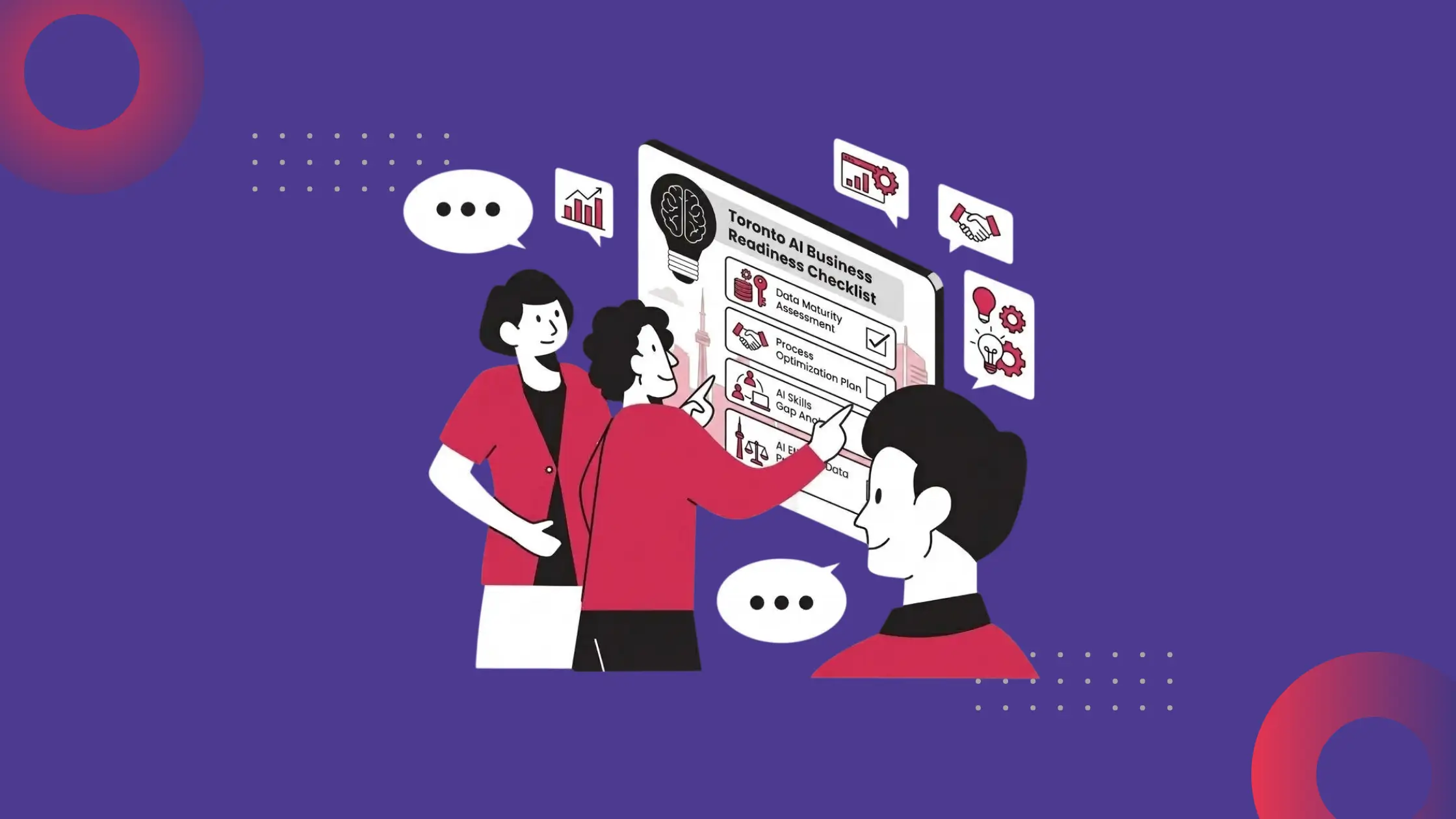
An AI Agency in Toronto can help businesses adopt AI, but first, you need to know if your business is ready. This checklist covers your data, workflows, technology, people, security, and ROI before you invest.
AI adoption is growing across Canada. Statistics Canada reported that 19.2% of Canadian businesses used AI to produce goods or deliver services in the 12 months leading up to Q2 2026, compared with 6.1% in Q2 2024. Data analytics, text analytics, and virtual agents or chatbots were among the common uses.
AI readiness means having the data, technology, processes, people, security, and clear business goals needed to successfully adopt and use AI. A business does not need to be fully AI-ready before starting; it needs to identify its gaps and begin with a practical, measurable use case. An AI Agency in Toronto can help assess those gaps and create an implementation plan.
A good AI readiness assessment looks at all of these before development starts.
For example, a company getting hundreds of the same customer questions every week might have a good reason to consider a chatbot. Another business might spend hours moving information between spreadsheets and its CRM. That could be a good case for AI workflow automation.
The point is simple: start with the problem, not the AI tool.
Before you invest in an AI project, take a close look at these seven areas.
This is where many businesses go wrong.
They start by asking, “What can AI do for us?”
That’s a huge question. It usually leads to a long list of tools and ideas without a clear next step.
Instead, look at the work your team does every day.
Where are people spending too much time? Which tasks are repetitive? Where do mistakes happen? What work keeps getting pushed back because it takes too long?
You might find opportunities in:
This is a much better starting point for AI adoption for businesses.
You don’t need ten AI projects. You may only need one that solves a real problem.
AI needs data. And not just lots of it.
It needs useful data.
Take a look at where your business information lives. Maybe it’s in a CRM, an ERP, spreadsheets, emails, cloud storage, databases, or several of these at once.
Now ask a few basic questions:
This is what data readiness is really about.
If the underlying information is poor, the AI system won’t magically fix it. In some cases, you may spend more time cleaning data than building the actual AI solution.
So check the data early.
Look at one process from beginning to end.
Say a new lead fills out a form on your website. Someone checks it, enters information into a CRM, sends an email, assigns the lead to a salesperson, and then follows up later.
How much of that is being done manually?
That is where AI workflow automation may help.
Depending on the business, AI automation can support things like:
But don’t automate a bad process just because you can.
If the process is confusing today, AI won’t necessarily make it better. It may just make the same mess happen faster.
Fix the workflow first. Then look at automation.
This is one of those areas that sounds technical until it becomes a real problem.
Your business may already use a CRM, ERP, website, mobile app, database, accounting system, or e-commerce platform. The AI solution may need to work with some or all of them.
That’s why AI integration for business needs to be considered early.
Check things like:
Sometimes an existing AI product will do the job.
Sometimes it won’t.
If your business has a very specific workflow, you may need custom development. That’s where an AI development company Toronto businesses can work with can help connect the business problem with the technical solution.
AI isn’t something you can hand over to the IT team and forget about.
Someone needs to understand what the system is doing. Someone needs to manage it. And the people using it need to know where AI fits into their daily work.
This is becoming more important as adoption grows.
KPMG reported in 2025 that 93% of surveyed Canadian business leaders said their organizations were using generative AI in some form. But only 31% said it was fully integrated into core operations and workflows.
That’s a big difference.
Using AI and getting real business value from AI are not the same thing.
Your team should know:
If you don’t have those skills internally, an AI agency for small business Toronto companies can be useful when you need outside development or consulting support.
This part shouldn’t be left until the end.
Before putting customer information, employee records, financial data, or internal documents into an AI system, understand where that information goes and who can access it.
Think about:
You also need some basic AI governance.
Who is allowed to use the system? What can they use it for? When does a person need to check the result?
These questions matter because AI can get things wrong.
KPMG’s 2025 research found that 58% of surveyed Canadians were extremely or very concerned about generative AI producing inaccurate responses or “hallucinations.”
So don’t treat security and governance as paperwork. Build them into the project from the start. You can also review this guide on AI ethics and responsibility to strengthen your governance approach.
This sounds obvious, but it’s often skipped.
Before building anything, decide what you want to improve.
Maybe you want to:
Pick a few numbers that you can actually track.
This matters because AI projects can become expensive if nobody knows what success looks like.
KPMG also reported in 2025 that only 2% of surveyed Canadian business leaders said they were already seeing a return on their generative AI investments.
That doesn’t mean AI can’t create value. It means businesses need to be much clearer about how they plan to get that value.
For a deeper look at measuring impact, see this guide on AI-powered predictive analytics.
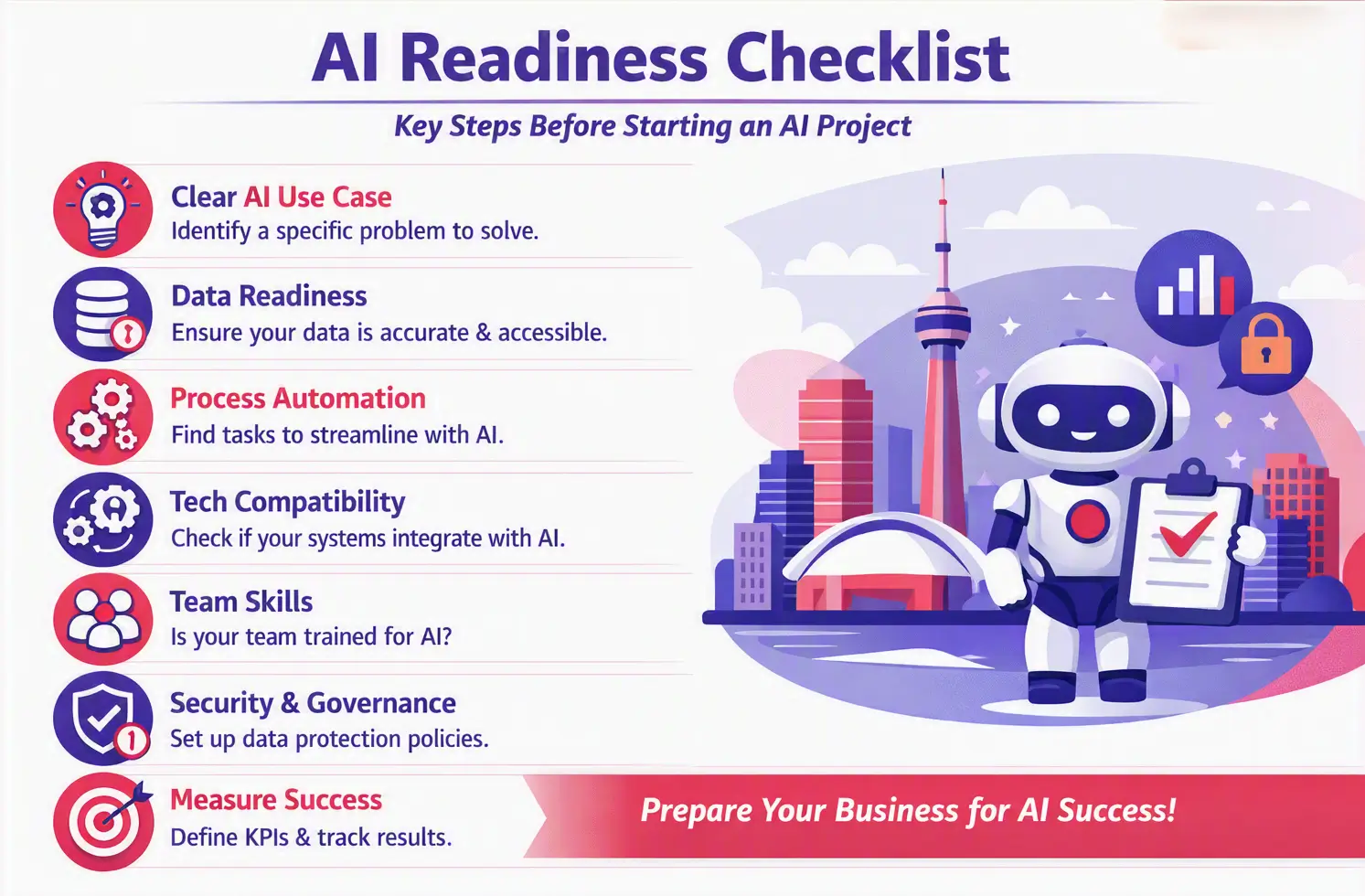
You can do a quick self-check.
Give yourself:
Score these seven areas:
Don’t treat the final number as a pass or fail.
If you have several 0s, you probably have some groundwork to do.
If most areas are at 1, you know where the gaps are.
If most are at 2, you may be in a good position to start a small AI project.
An AI readiness assessment for businesses in Toronto can also help when you want a more detailed review before making a larger investment.
Most businesses don’t struggle because they can’t find an AI tool.
They struggle because they don’t know where that tool fits.
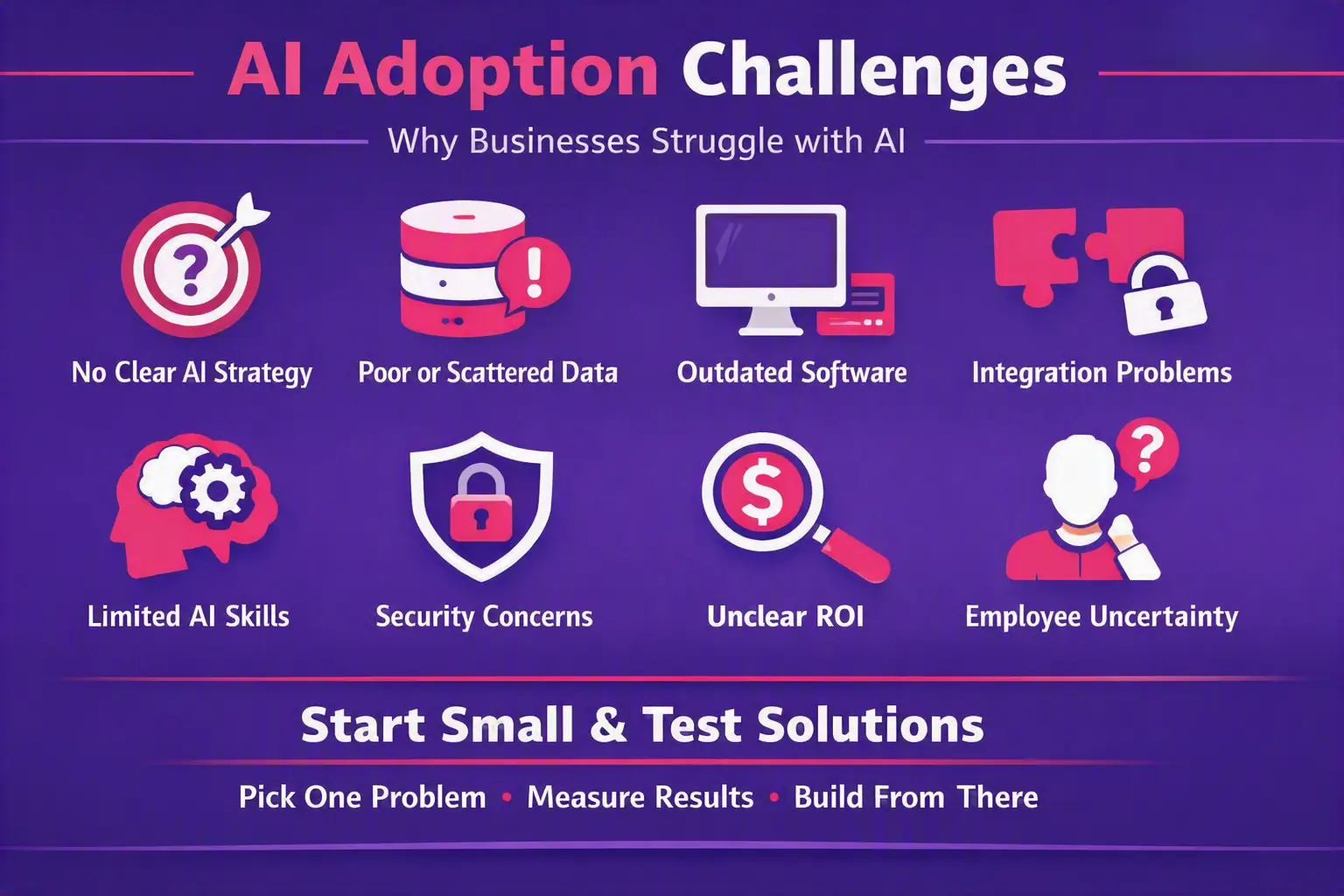
Some common problems include:
Statistics Canada found that businesses that were not planning to adopt AI commonly pointed to reasons such as AI not being relevant to their business, a lack of knowledge about AI capabilities, and privacy or security concerns.
That’s why starting small can make sense.
Pick one problem. Test one solution. Measure what happens.
If it works, build from there.
You don’t necessarily need an agency just because you’re interested in AI.
But outside help can make sense when you know there is an opportunity and don’t have the people or experience to handle it yourself.
You may need help with:
When comparing an AI consulting company Toronto businesses can hire, don’t focus only on the technology they mention.
Ask whether they understand your actual business process.
Can they work with your current systems? Do they understand data security? Can they explain what the first version will look like? Will they help measure the result?
Those questions tell you much more than a long list of AI buzzwords.
If you’re trying to choose an AI agency in Toronto, start with the basics.
Ask potential providers:
A good AI technology partner Toronto businesses work with should be able to talk about both sides of the project: the business side and the technical side.
There isn’t one AI solution that works for every company.
A retail business may need recommendations or customer support. A professional services firm may get more value from document processing. A company with a large sales operation may benefit from predictive analytics.
Some common AI use cases include:
Statistics Canada reported that data analytics was the most common AI application among Canadian businesses using AI in Q2 2026, followed by text analytics and virtual agents or chatbots.
So the better question isn’t “What AI should we use?”
It’s “Where would AI actually help us?”
AI doesn’t need to start with a big project.
In many cases, it shouldn’t.
Start with the work that is slowing your business down. Look at the data behind it. Check whether your current systems can support a solution. Talk to the people who actually do the work every day. Then decide what AI can realistically improve.
That’s the real purpose of an AI readiness checklist.
For Toronto businesses, AI adoption is moving quickly. But moving quickly doesn’t mean making rushed decisions. A sensible AI business strategy gives you room to test an idea, measure the result, fix what isn’t working, and then decide whether it is worth scaling.
If you’re still asking, “Is my business ready for AI?”, that’s a good place to start.
If you need AI consulting, AI integration, AI workflow automation, or custom AI development, talk to Let’s Nurture about what you are trying to achieve.